Yoga Toning Potential Calculator
Answer the following questions to estimate your results.
Toning Probability
Select Options
Make selections on the left to see your estimated progress timeline and likelihood of visible toning.
You look in the mirror after a month of daily practice. Your balance has improved. Your shoulders feel lighter. But your arms still look soft. Did you waste your time? This is the single most common question I hear from people switching from the gym to the mat. The short answer is yes, you can get toned from just doing yoga. But it depends entirely on what kind of yoga you are doing and how you define "toned."
Most people think yoga is just stretching. If that were true, you would never build any strength. In reality, Yoga is a physical, mental, and spiritual discipline that includes postures (asanas), breath control (pranayama), and meditation. When performed correctly, many asanas require significant muscular endurance. You are holding your body weight against gravity. This creates tension. That tension builds muscle.
The Science Behind Getting Toned
To understand if yoga works for you, we need to look at how muscles grow. There are two main types of muscle contractions: concentric and eccentric. When you lift a dumbbell, you shorten the muscle (concentric) and then lengthen it under load (eccentric). Yoga relies heavily on Isometric Contractions are muscle actions where tension increases without changing the length of the muscle.
Think about holding a Plank Pose (Phalakasana). Your core muscles are screaming, but your elbows aren't moving. You are fighting gravity statically. Studies show that isometric training can increase muscle strength and size, especially when held for longer durations or when combined with movement. It doesn't build bulk like heavy deadlifts, but it creates lean, defined muscle fibers. This is what people mean by "toned."
Another factor is muscle density. Yoga improves neuromuscular connection. You learn to fire muscles you didn't know you had. When these muscles engage consistently, they become firmer. You might not see huge biceps, but your posture improves, making your body look more sculpted and aligned.
Not All Yoga Classes Are Created Equal
If you want visible changes, you cannot rely solely on restorative classes. You need styles that challenge your strength. Here is how different styles stack up for building tone:
| Yoga Style | Intensity Level | Muscle Focus | Best For Toning? |
|---|---|---|---|
| Vinyasa Flow is a dynamic style linking breath with continuous movement through sequences of poses | High | Full Body, Core, Arms | Yes - High repetition builds endurance |
| Ashtanga Yoga is a rigorous, set sequence of postures practiced in a specific order with intense focus on alignment and breath | Very High | Core, Shoulders, Legs | Yes - Consistent, demanding routine |
| Power Yoga is a fitness-based approach to vinyasa-style yoga emphasizing strength and stamina | High | Upper Body, Glutes | Yes - Often incorporates weights |
| Hatha Yoga is a general term for physical postures, often taught at a slower pace with longer holds | Medium | Flexibility, Stability | Moderate - Good for beginners |
| Restorative Yoga is a gentle style using props to support the body in passive poses for relaxation | Low | Nervous System Calm | No - Minimal muscle engagement |
If you are only doing Restorative or Yin yoga, you will gain flexibility and stress relief, but don't expect arm definition. To get toned, you need the heat and repetition found in Vinyasa or Ashtanga. These styles keep your heart rate up and force your muscles to work continuously. You are essentially doing bodyweight calisthenics.
Key Poses That Build Muscle
Certain poses act as direct replacements for traditional gym exercises. If you incorporate these into your daily routine, you will see changes.
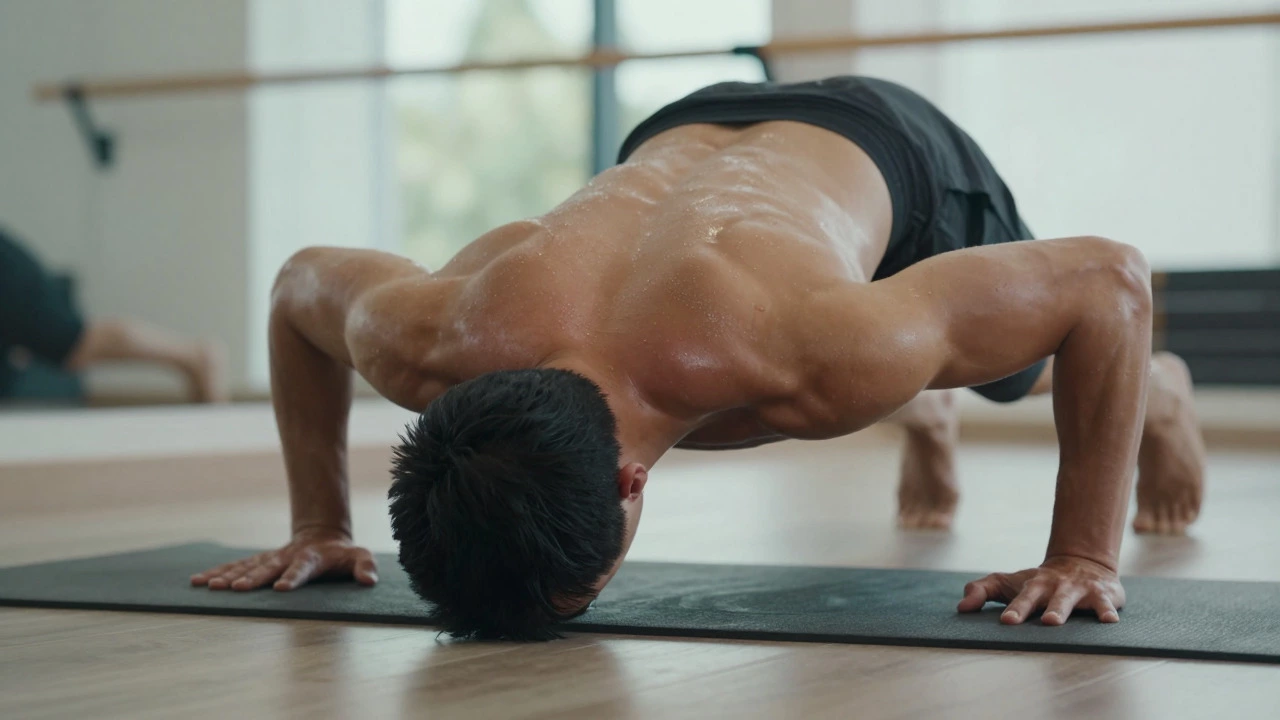
- Chaturanga Dandasana (Four-Limbed Staff Pose): This is the yoga equivalent of a push-up. It targets the triceps, chest, and shoulders. Most people struggle here because they lack upper body strength. Mastering this pose will visibly tone your arms.
- Warrior III (Virabhadrasana III): A balancing pose that requires immense glute and hamstring engagement. Holding this stabilizes your legs and builds posterior chain strength.
- Side Plank (Vasisthasana): Targets the obliques and outer hips. It sculpts the waistline and strengthens the shoulders.
- Chair Pose (Utkatasana): Works the quadriceps and glutes. Holding this for multiple rounds builds leg endurance similar to squats.
- Boat Pose (Navasana): A core crusher. It strengthens the rectus abdominis and hip flexors, leading to a flatter stomach appearance.
The secret isn't just doing the pose once. It's holding it. Or flowing through it ten times in a row. Progressive overload applies to yoga too. You must make the poses harder over time. Hold them longer. Add variations. If Chaturanga feels easy, try lowering yourself slower. If Warrior III is stable, close your eyes or lift your front knee higher.
The Role of Nutrition and Body Fat
Here is the hard truth. You can have strong, toned muscles underneath, but if they are covered by a layer of fat, they won't show. Yoga burns calories, but usually fewer than running or HIIT (High-Intensity Interval Training). A 60-minute Vinyasa class might burn 300-450 calories depending on your weight and intensity. Running the same duration could burn 600+.
To get "toned," you need low enough body fat percentage for muscle definition to be visible. For women, this is typically around 18-22%. For men, 10-14%. If you do yoga but eat in a calorie surplus, you will build muscle but also store fat. You will get stronger, but not necessarily "toned" in the aesthetic sense.
Protein intake matters too. Muscles repair and grow with protein. If you are vegan or vegetarian (common in yoga communities), ensure you are getting enough plant-based protein from lentils, tofu, quinoa, or supplements. Without adequate protein, your muscles cannot recover from the strain of intense practices like Ashtanga.
Yoga vs. Weightlifting: What’s the Difference?
Many people ask if they should choose one over the other. Let's compare them directly.
Weightlifting uses external resistance. You add more weight to the bar. This is the fastest way to build raw mass and maximum strength. Yoga uses internal resistance (body weight). It builds functional strength, flexibility, and balance simultaneously.
Weightlifting often isolates muscles. Bicep curls target only the biceps. Yoga integrates muscles. A Sun Salutation engages your hamstrings, back, shoulders, and core all at once. This leads to better overall body composition and injury prevention. However, yoga rarely builds large muscle bellies. If your goal is to look like a bodybuilder, stick to the gym. If your goal is a lean, athletic, flexible physique, yoga is superior.
Interestingly, combining both yields the best results. Many athletes use yoga to improve mobility and prevent injuries from heavy lifting. The increased range of motion allows for deeper squats and better form, which ironically helps you lift heavier safely.
How Long Does It Take to See Results?
Patience is key. Muscle adaptation takes time. With consistent practice (3-5 times per week), you may notice improved posture and muscle firmness within 4-6 weeks. Visible toning, such as defined arms or abs, typically takes 3-6 months. Genetics play a role too. Some people store fat differently. Others have naturally higher muscle density.
Track your progress beyond the mirror. Take measurements. Notice how clothes fit. Can you hold a plank longer? Can you balance on one leg easily? These are signs of increasing muscle tone and strength, even if the scale hasn't moved.
Common Mistakes That Stop Progress
Even if you practice daily, you might not get toned if you make these errors:
- Using Momentum: Swinging into Downward Dog instead of pressing through the hands. Control the movement. Slow down. Feel the burn.
- Skiping Arm Balances: Avoiding Crow Pose or Side Plank because they are hard. These are the most effective toning poses. Embrace the challenge.
- Inconsistent Practice: Doing one intense class a week isn't enough. Frequency matters. Aim for 4-5 sessions weekly.
- Poor Alignment: If your wrist hurts in Chaturanga, you might be collapsing. Engage your core and press firmly. Proper alignment ensures the right muscles are working.
- Ignoring Recovery: Muscles grow during rest, not during the workout. Sleep 7-9 hours. Eat well. Overtraining leads to fatigue, not tone.
Final Thoughts on Your Journey
Can you get toned from just doing yoga? Absolutely. But you have to treat it like a workout, not just relaxation. Choose dynamic styles. Challenge your strength. Fuel your body properly. Be patient. The result won't be bulky, but it will be strong, lean, and capable. Your body will move better, feel better, and look better. And that is worth more than any number on a scale.
Will yoga give me big muscles?
No, yoga typically builds lean, dense muscle rather than large bulk. It focuses on endurance and functional strength. Unless you combine it with heavy weightlifting and a high-calorie diet, you are unlikely to develop large muscle mass.
How many times a week should I do yoga to get toned?
For noticeable toning, aim for 4-5 sessions per week. Include at least 2-3 dynamic styles like Vinyasa or Power Yoga. Consistency is crucial for progressive overload and muscle adaptation.
Can yoga reduce belly fat?
Yoga can help reduce belly fat indirectly by boosting metabolism, reducing stress (which lowers cortisol), and strengthening core muscles. However, spot reduction is a myth. You need an overall calorie deficit to lose fat from your abdomen.
Is yoga better than cardio for toning?
Cardio burns more calories quickly, aiding fat loss. Yoga builds muscle definition and endurance. For a toned look, you need both low body fat and muscle structure. Yoga provides the muscle structure; cardio helps strip the fat. Combining both is ideal.
What is the best yoga pose for arm toning?
Chaturanga Dandasana (Four-Limbed Staff Pose) is the most effective for arm toning. It targets the triceps, deltoids, and chest. Incorporating arm balances like Crow Pose or Side Plank also significantly strengthens and defines the arms.