The Eight Limbs of Yoga Explorer
Select any principle below to discover its meaning and how it connects to your spiritual practice.
Explore the Path
Click on a limb above to reveal its definition and practical application in daily life.
Walk into any modern gym or studio, and you will likely see people stretching on mats, focusing on their breathing, and perhaps holding a difficult pose. It looks like exercise. It feels like a workout. But if you ask someone who has practiced for decades, they might tell you that what you are seeing is only the surface. The real magic happens in the mind and the soul. This raises a fundamental question: how does yoga relate to spirituality?
For many, the word "spirituality" brings up images of monks in robes, chanting in temples, or retreating to mountains to meditate for years. It can feel distant, religious, or even intimidating. Yet, yoga was born from these exact traditions. To understand yoga fully, we have to look past the physical postures and explore the ancient Indian philosophy that created it. You don't need to be a monk to benefit from this connection, but understanding it changes how you practice.
The Original Blueprint: What Was Yoga Designed For?
To get to the heart of the matter, we need to go back to where it all started. Yoga originated in ancient India thousands of years ago. It wasn't invented as a fitness routine to build muscle or improve flexibility. It was developed as a tool for self-realization. The goal was not to look good; the goal was to wake up.
The foundational text of yoga is the Yoga Sutras of Patanjali, which is a collection of 196 aphorisms that outline the path to mental clarity and spiritual liberation. Written around 400 CE, though based on older oral traditions, this text defines yoga not as stretching, but as "chitta vritti nirodhah." In simple terms, this means "the stilling of the fluctuations of the mind." When the mind stops chattering, judging, and worrying, you can see your true nature. That state of clear awareness is the spiritual core of yoga.
Patanjali laid out an eight-step path known as the Astanga Yoga, also known as Eight Limbs of Yoga. This system is a comprehensive guide to ethical living, physical health, and meditation. Most people today focus almost entirely on one limb: Asana (postures). But Asana is just step three of eight. If you ignore the other seven, you are missing most of the picture. The first two limbs deal with ethics and discipline. The last four deal with concentration, meditation, and enlightenment. Physical postures were designed to prepare the body to sit still for long periods of meditation. Without the spiritual context, the physical practice loses its primary purpose.
Beyond the Mat: The Ethical Foundation
If you think spirituality is only about feeling calm during meditation, you might be surprised by how much of traditional yoga is about how you treat other people. The first two limbs of Patanjali's system are Yama and Niyama. These are moral codes and personal observances. They are not optional extras; they are the foundation.
Yama includes five principles:
- Ahimsa (Non-violence): Not harming others through action, speech, or thought. This is why many yogis become vegetarians or vegans. It’s about reducing harm to living beings.
- Satya (Truthfulness): Being honest with yourself and others.
- Asteya (Non-stealing): Not taking what isn't yours, including time, credit, or energy.
- Brahmacharya (Moderation): Using your energy wisely, often interpreted as sexual moderation or conservation of vital energy.
- Aparigraha (Non-greed): Letting go of attachment to material possessions and outcomes.
Niyama focuses on internal discipline:
- Sauca (Purity): Keeping your body and mind clean.
- Santosha (Contentment): Finding joy in what you have right now.
- Tapas (Discipline): Doing the hard work even when you don't feel like it.
- Svadhyaya (Self-study): Reflecting on your own thoughts and actions.
- Ishvara Pranidhana (Surrender): Trusting a higher power or the universe.
When you practice yoga with these principles in mind, every breath becomes a spiritual act. You aren't just bending forward; you are practicing humility. You aren't just standing tall; you are practicing confidence without arrogance. This transforms the practice from a physical exercise into a way of life.
The Body as a Temple: Why We Move
So, why do we do the poses at all? If the goal is stillness, why move? In ancient Indian philosophy, the body is seen as a vehicle for the soul. If the vehicle is broken, dirty, or uncomfortable, it’s hard to travel anywhere. Asanas (postures) are designed to remove blockages in the body. These blockages can be physical tension, poor circulation, or stagnant energy.
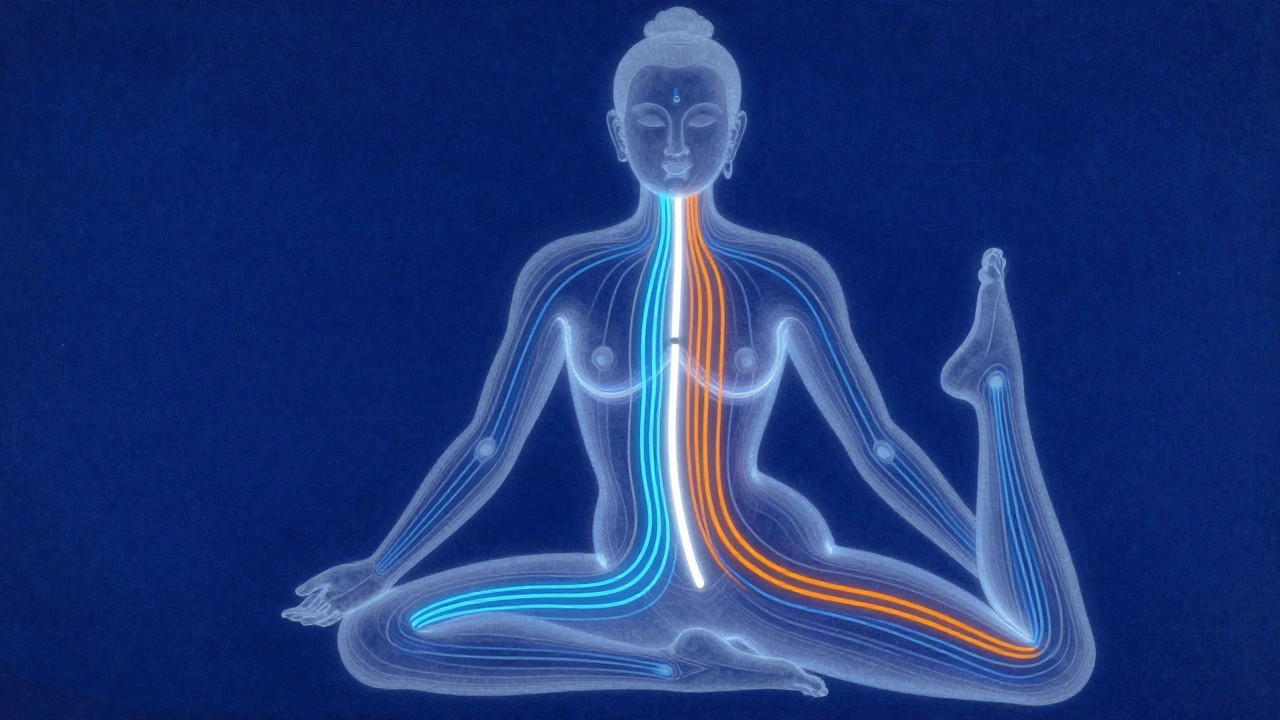
In yoga tradition, energy flows through channels called nadis. There are said to be 72,000 nadis in the subtle body, but two main ones stand out: Ida (cool, lunar energy) and Pingala (hot, solar energy). When these energies flow freely and balance each other, a third channel, Sushumna, opens up. This central channel runs along the spine. Awakening the energy in Sushumna is considered key to spiritual awakening.
Physical postures help align the spine and relax the nervous system. When the body is relaxed, the mind follows. Think about it: when you are stressed, your shoulders are tight, your jaw is clenched, and your breath is shallow. When you consciously relax those areas, your stress levels drop. This physiological shift creates the conditions necessary for deeper states of consciousness. The pose itself isn't the goal; the inner peace that results from the pose is.
| Aspect | Modern Fitness Approach | Traditional Spiritual Approach |
|---|---|---|
| Primary Goal | Physical strength, weight loss, flexibility | Mental stillness, self-realization, liberation |
| Focus During Practice | External appearance, counting reps, music | Internal sensation, breath control, silence |
| Role of Ethics | Minimal or none | Central (Yamas and Niyamas) |
| View of the Body | Machine to be optimized | Temple for the soul |
| Outcome | Temporary endorphin rush | Lasting inner peace and clarity |
Breath as the Bridge: Pranayama
If asana prepares the body, pranayama prepares the mind. Pranayama is the practice of controlling the breath. In Sanskrit, "prana" means life force or energy, and "ayama" means extension or control. So, pranayama is the regulation of life force.
Why is breath so important? Because it is the only autonomic function we can control voluntarily. Your heart beats without you thinking about it. Your liver filters blood automatically. But you can choose to breathe deeply, quickly, slowly, or hold your breath. This makes the breath a powerful bridge between the conscious mind and the subconscious body.
When you are anxious, your breath is short and shallow. When you are angry, it is fast and erratic. By consciously changing your breathing pattern, you can change your emotional state. For example, slow, deep belly breathing activates the parasympathetic nervous system, which tells your body to rest and digest. This calms the mind instantly. In spiritual terms, regulating prana helps balance the doshas (body-mind constitutions) and clears the nadis (energy channels), making meditation easier and more effective.
Meditation: The Destination
All the previous steps-ethics, postures, breath control-are meant to lead to Dharana (concentration), Dhyana (meditation), and Samadhi (bliss or union). Meditation is not just sitting quietly. It is the practice of witnessing your thoughts without getting caught up in them.
In a busy world, our minds are constantly jumping from one thought to another. We worry about the past, plan for the future, and rarely live in the present moment. Meditation trains the mind to stay in the now. Over time, this practice leads to a state where the observer and the observed become one. You realize that you are not your thoughts, your emotions, or your body. You are the awareness behind them all. This realization is the essence of spirituality in yoga.
Samadhi is described as a state of super-consciousness. It is not a trance or a sleep state. It is a heightened state of awareness where you feel connected to everything around you. Ego dissolves. Separation disappears. You experience pure existence. While this may sound abstract, many practitioners report moments of profound peace, joy, and clarity during deep meditation sessions.
Does Yoga Have to Be Religious?
This is a common concern. Many people wonder if practicing yoga means adopting Hindu beliefs. The answer is no. Yoga is a universal science of the mind and body. While its roots are in Hinduism, Buddhism, and Jainism, the practices themselves are secular. You can practice yoga without believing in any specific god or religion.
Think of yoga like mathematics. Math was developed by various cultures over centuries, but you don't need to believe in any particular culture to use math. Similarly, yoga provides tools for mental and physical well-being that anyone can use, regardless of their background. However, ignoring the spiritual roots completely is like using a map without reading the legend. You might get somewhere, but you won't understand the terrain.
Many modern studios strip away the spiritual elements to make yoga more palatable to a Western audience. This is fine for beginners who just want to stretch. But if you want to go deeper, exploring the spiritual aspects can enrich your practice significantly. It adds meaning and purpose to the movements.
Finding Your Own Path
So, how does yoga relate to spirituality? It is the vehicle that carries you from the physical world to the spiritual realm. It starts with ethical living, moves through physical purification, uses breath to calm the mind, and culminates in meditation and self-realization. It is a holistic system that addresses every aspect of human existence.
You don't have to follow every rule perfectly. Start where you are. Maybe that means paying attention to your breath during a downward dog. Maybe it means practicing non-judgment when you fall out of a pose. Maybe it means reflecting on your day before bed. Each small step counts. The journey is personal, and there is no single right way to do it. The only requirement is curiosity and openness.
As you continue your practice, notice how your mindset shifts. Do you react less impulsively? Are you more patient? Do you feel more connected to others? These are signs that the spiritual side of yoga is working. It’s not about becoming perfect; it’s about becoming aware. And in that awareness, you find freedom.
Is yoga a religion?
No, yoga is not a religion. It is a philosophical and practical system for physical, mental, and spiritual well-being. While it has roots in ancient Indian religions like Hinduism and Buddhism, its practices are secular and can be adopted by anyone, regardless of their faith or lack thereof.
Can I practice yoga without the spiritual part?
Yes, you can. Many people practice yoga solely for its physical benefits, such as improved flexibility, strength, and stress relief. However, incorporating some spiritual elements, like mindful breathing or ethical reflection, can deepen the experience and provide additional mental health benefits.
What is the difference between Hatha yoga and Ashtanga yoga?
Hatha yoga is a broad term that refers to the physical aspects of yoga, including postures and breath control. It is generally slower-paced and suitable for beginners. Ashtanga yoga is a specific style within the Hatha tradition that follows a fixed sequence of poses performed in a vigorous, flowing manner. It is more physically demanding and emphasizes discipline and consistency.
How long does it take to experience spiritual benefits from yoga?
There is no set timeline. Some people report feeling immediate calm and clarity after a single session. Others may take months or years of consistent practice to experience deeper states of meditation or self-realization. The key is regularity and intentionality in your practice.
Do I need to meditate to get spiritual benefits from yoga?
Meditation is a core component of traditional yoga and is highly recommended for spiritual growth. However, mindfulness can be practiced during physical postures and daily activities. Even without formal seated meditation, being present and aware during your yoga practice can yield significant spiritual insights.