Cultural Diversity Comparator
Select a category below to see how India and the United States compare in specific aspects of cultural diversity.
India
19,500+ Mother Tongues
Diversity driven by internal evolution over millennia. Distinct scripts and literary histories (e.g., Tamil vs. Punjabi).
United States
~350 Languages Spoken
English dominant. Spanish growing. Diversity defined by global immigration rather than indigenous roots.
India
Birthplace of Major Faiths
Hinduism, Buddhism, Jainism, Sikhism born here. High density of temples, mosques, churches within walking distance.
United States
Christian Majority
Growing secular/unaffiliated population. Religious groups often segregated by neighborhood or region.
India
Deep Immersion
Spectator of ancient traditions. Moving from Kerala to Kashmir feels like crossing international borders.
United States
Global Sampling
Participant in modern coexistence. Sample global cuisines and cultures without leaving North America.
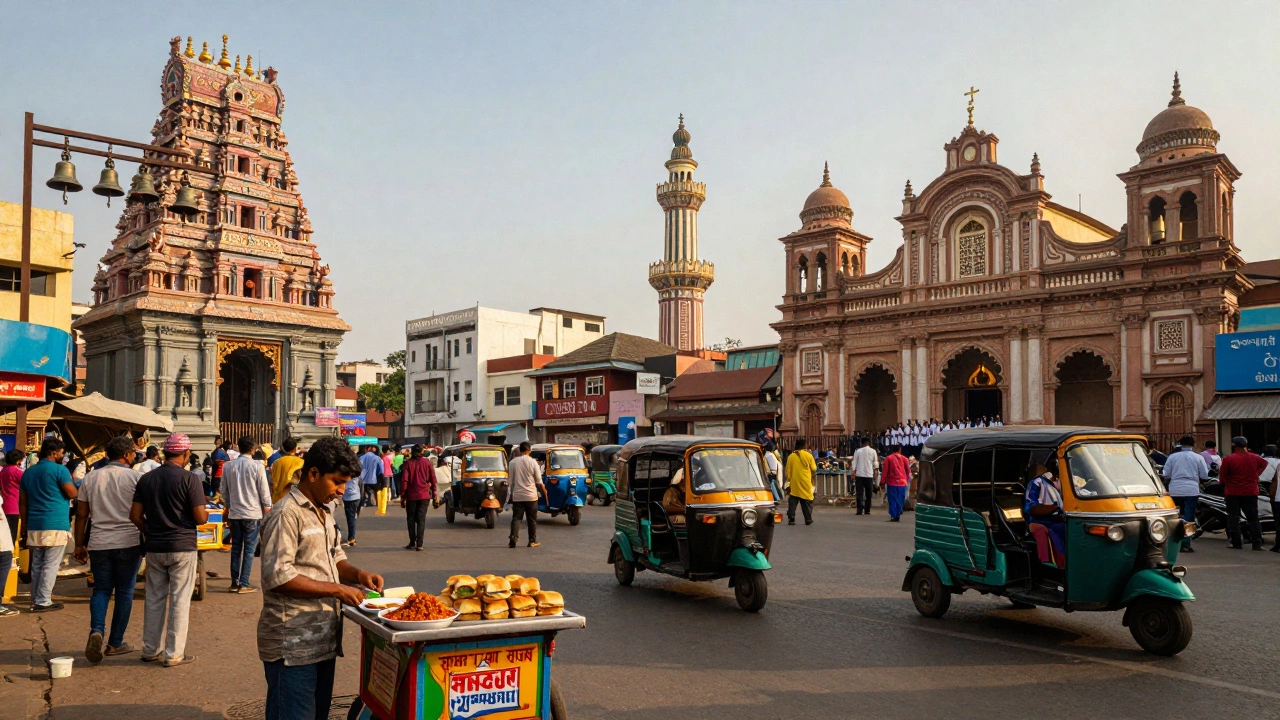
Picture this: You are standing in the chaotic, vibrant streets of Mumbai. To your left, a street vendor sells spicy vada pav. To your right, a temple bell rings out over the noise of auto-rickshaws. Behind you, a church choir practices for Sunday mass. In front of you, a mosque calls for prayer. This isn't a movie set; it is Tuesday morning in one of the world's most diverse nations.
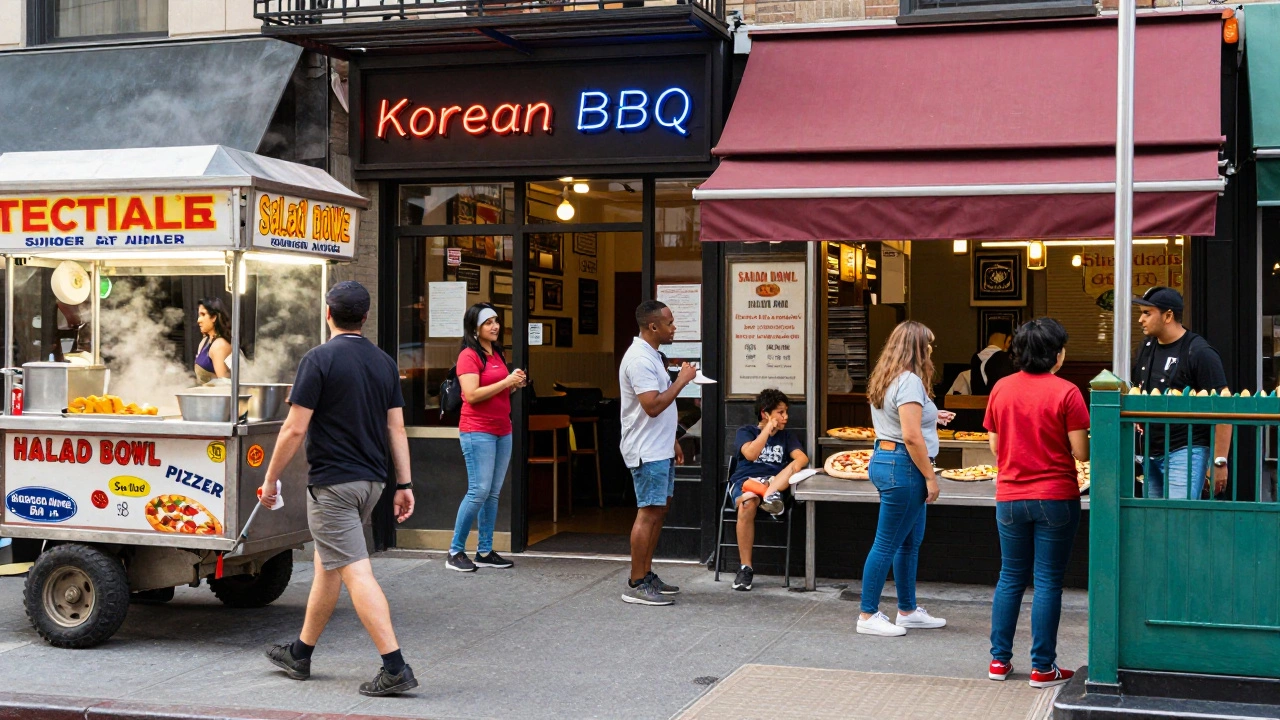
Now, picture yourself in New York City. You walk past a halal cart, then into a Korean BBQ restaurant, grab a slice of pizza from an Italian-owned shop, and hear Spanish being spoken on the subway. It feels incredibly varied, doesn't it?
So, when people ask, "Is America more diverse than India?" they are usually comparing two very different kinds of variety. One is built on centuries of internal evolution, while the other is constructed through modern immigration. As someone who has spent years exploring both landscapes, I can tell you that the answer depends entirely on how you define "diversity." If you mean language, religion, and ethnicity within borders, India wins by a landslide. If you mean national origins and global exposure, the United States has a strong claim. Let’s break down what this means for travelers seeking authentic cultural experiences.
The Depth of Indigenous Diversity in India
To understand why India is often called the "most diverse country" in terms of indigenous roots, you have to look at its history. India hasn't just absorbed outsiders; it has evolved internally for thousands of years. The concept of Bharat (the native name for India) encompasses a subcontinent where geography dictated culture. Mountains, deserts, and coastlines created isolated pockets that developed unique languages, foods, and traditions.
Consider language alone. The Census of India lists over 19,500 mother tongues. While English and Hindi serve as lingua francas, speaking Bengali in Kolkata feels worlds apart from speaking Tamil in Chennai or Punjabi in Amritsar. These aren't just dialects; they represent distinct literary histories, scripts, and worldviews. In contrast, the United States primarily operates in English, with Spanish growing significantly but still secondary in many official contexts. For a traveler, moving from Kerala to Kashmir is like crossing international borders without leaving the country.
Religion adds another layer. India is the birthplace of four major world religions: Hinduism, Buddhism, Jainism, and Sikhism. It also hosts ancient communities of Muslims, Christians, Jews, and Zoroastrians (Parsis). Unlike countries where religious groups might be segregated by neighborhood, Indian cities often feature temples, mosques, churches, and gurudwaras within walking distance of each other. This proximity creates a daily, lived experience of pluralism that is rare elsewhere.
The Breadth of Immigrant Diversity in America
The United States tells a different story. Its diversity is largely defined by immigration. Since its founding, America has been a destination for people fleeing war, poverty, or persecution, or seeking opportunity. Today, the U.S. is home to immigrants from every corner of the globe. According to recent data, nearly 45 million people living in the U.S. were born in another country. That is roughly 13% of the total population.
This immigrant-driven diversity creates a mosaic of national identities. In Los Angeles, you can find entire neighborhoods that feel distinctly Mexican, Filipino, or Vietnamese. In New Jersey, South Asian communities thrive alongside Caribbean and Eastern European enclaves. The diversity here is about origin stories. Americans often identify strongly with their ancestral homelands-Italian-American, Irish-American, Nigerian-American-and these identities shape food, festivals, and social circles.
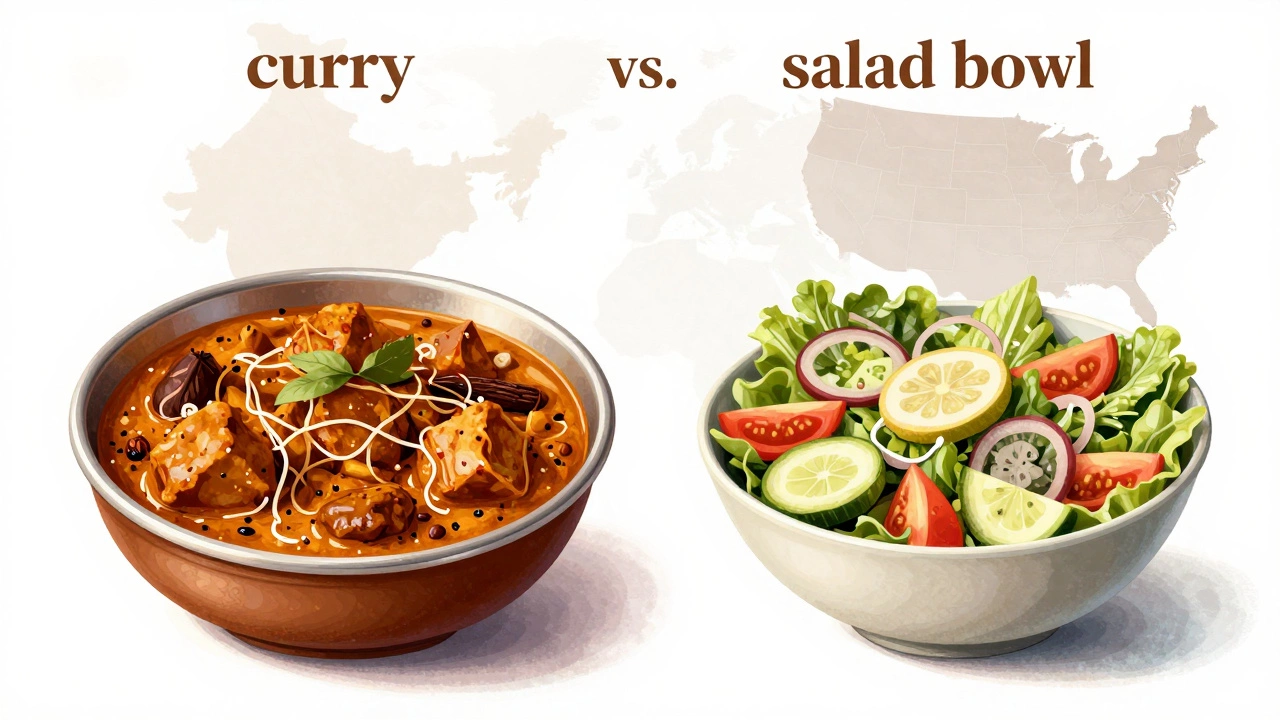
For tourists, this makes the U.S. a place where you can sample "global" cultures without leaving North America. However, there is a catch. Much of this diversity exists in parallel rather than in integration. While Indians and Americans interact, the deep, historical interweaving of cultures seen in India is less common in the U.S. American diversity is often described as a "salad bowl," where ingredients remain distinct. Indian diversity is more like a "curry," where spices blend over time to create a complex, unified flavor profile that still retains individual notes.
Comparing Social Fabric and Integration
How do these societies handle difference? This is where the comparison gets tricky. In India, diversity is often managed through caste, community, and regional identity. These systems are deeply entrenched and can be exclusionary, yet they also provide a sense of belonging. People know their place in the social hierarchy, which can reduce friction but also limit mobility. Inter-community marriage is increasing but remains less common than intra-community unions.
In the United States, the ideal is assimilation into a broader "American" identity, though this model is shifting toward multiculturalism. Interracial and interethnic marriages are far more common in the U.S. than in India. A 2023 Pew Research Center study noted that mixed-race relationships are rising rapidly among younger generations. This suggests a level of social blending that India does not currently see. However, this blending comes with its own tensions, including ongoing debates about race, equity, and representation.
For the cultural tourist, this means different things. In India, you observe diversity as a spectator of ancient traditions continuing side-by-side. In America, you witness diversity as a participant in a dynamic, evolving experiment in coexistence. Neither is "better," but they offer vastly different insights into human nature.
| Aspect | India | United States |
|---|---|---|
| Primary Driver | Internal evolution & geography | Immigration & policy |
| Languages | 19,500+ mother tongues | English dominant, ~350 languages spoken |
| Religious Landscape | Birthplace of major faiths; high density | Christian majority; growing secular/unaffiliated |
| Social Structure | Caste, region, community-based | Race, class, ethnic identity-based |
| Tourist Experience | Deep immersion in local traditions | Sampling global cuisines/cultures |
What This Means for Cultural Tourists
If you are planning a trip based on the promise of diversity, your goals will dictate your destination. Are you looking to understand how humanity has organized itself for millennia? Go to India. Walk through the old city of Delhi, where Mughal architecture stands next to British colonial buildings and modern skyscrapers. Eat street food that changes every five miles. Listen to the clash and harmony of languages. You will see a society that has learned to live with immense difference because it had no choice.
Are you interested in seeing how the world converges in a modern, capitalist hub? Go to the United States. Visit Chicago’s Pilsen neighborhood for Latino art, then head to Hyde Park for African American history, and finish in Chinatown. You will see how global cultures adapt to a new environment. You will taste fusion dishes that wouldn’t exist anywhere else. You will meet people whose grandparents came from continents away, yet who share a common civic identity.
One mistake many travelers make is assuming that "diverse" means "welcoming." Both countries have significant challenges with discrimination. India struggles with communal violence and caste prejudice. The U.S. grapples with systemic racism and xenophobia. A smart traveler acknowledges these realities. They don’t just visit the tourist traps; they talk to locals, read contemporary literature, and understand the tensions beneath the surface.
The Role of Media and Perception
Why do so many people believe America is more diverse? Partly because of media visibility. Hollywood, Silicon Valley, and Wall Street project a global image of the U.S. as a melting pot. We see American shows featuring multi-ethnic casts, reinforcing the idea of a post-racial society. India’s cultural exports, such as Bollywood and yoga, are huge, but they often present a more homogenized view of Indian life, focusing on urban, upper-class narratives.
However, reality on the ground tells a different story. In rural India, diversity is subtle but profound. A village in Odisha may practice tribal rituals that differ sharply from those in neighboring Andhra Pradesh. In small-town America, diversity can be starkly limited. Many regions have little exposure to cultures outside their immediate demographic. So, while the U.S. has greater *national* diversity, India has greater *local* diversity in many areas.
Navigating the Complexity: Tips for Travelers
To get the most out of your journey, keep these tips in mind:
- Go beyond the capital: In India, don’t just stay in Mumbai or Delhi. Visit Varanasi for spiritual depth, Kochi for colonial and Jewish history, or Jaipur for Rajput culture. Each offers a distinct window into Indian diversity.
- Explore ethnic enclaves: In the U.S., seek out specific neighborhoods. Little Ethiopia in Washington D.C., Koreatown in Los Angeles, or Brighton Beach in New York. These places preserve cultural authenticity better than mainstream areas.
- Learn basic phrases: In India, learning a few words in the local language (not just Hindi) shows respect and opens doors. In the U.S., understanding slang and regional accents helps you connect across racial lines.
- Respect boundaries: Photography rules vary widely. In India, always ask before photographing people, especially in religious sites. In the U.S., be mindful of privacy laws and personal space, particularly in sensitive communities.
- Eat locally: Food is the easiest way to experience diversity. In India, try regional specialties like dosa in the south or thali in the north. In the U.S., seek out authentic ethnic restaurants run by first-generation immigrants, not chain versions.
Final Thoughts on Global Pluralism
So, is America more diverse than India? If you count the number of distinct ethnic, linguistic, and religious groups originating within the borders, India is unrivaled. It is a continent disguised as a country. If you count the number of nationalities represented and the degree of global connectivity, the United States leads. It is a microcosm of the world.
For the cultural tourist, both destinations offer unparalleled opportunities to challenge assumptions and broaden perspectives. India teaches us that diversity can be ancient, layered, and sometimes contradictory. America teaches us that diversity can be chosen, dynamic, and constantly renegotiated. The best travelers don’t pick a winner; they appreciate the unique strengths of both models. After all, understanding our differences is the first step toward building a more connected world.
Which country has more languages?
India has significantly more languages. The Census of India records over 19,500 mother tongues, whereas the United States has around 350 languages spoken, with English being the dominant language for government and business.
Is it easier to travel in India or the US due to language barriers?
Generally, the US is easier for English speakers since English is the primary language. In India, while English is widely understood in cities and tourist areas, regional languages dominate daily life, which can require translation apps or local guides for deeper interactions.
Can I experience multiple religions in one day in India?
Yes. Cities like Mumbai, Delhi, and Hyderabad have temples, mosques, churches, and gurudwaras located close together. It is common for visitors to visit a Hindu temple in the morning, a Muslim shrine in the afternoon, and a Christian church in the evening.
Where is the highest concentration of immigrants in the US?
California, Texas, Florida, and New York have the largest immigrant populations. Major metropolitan areas like Los Angeles, New York City, Houston, and Miami are particularly diverse, with some neighborhoods having over 50% foreign-born residents.
Is India safe for solo female travelers despite its diversity?
Safety varies by region and circumstance. While many women travel safely in India, it requires more caution and research than the US. Staying in populated areas, dressing modestly, and using reputable transport services are recommended. The US generally has higher infrastructure safety standards for tourists.