Om Consciousness Explorer
Click a component below to explore its spiritual and cosmic significance.
Sound: "A"
Sound: "U"
Sound: "M"
Silence (Turiya)
Quick Takeaways
- Om (or Aum) is the primary sacred sound and symbol in Hinduism, representing the essence of the ultimate reality.
- The symbol is a visual map of consciousness, from the waking state to the deepest state of sleep.
- It is composed of three phonetic sounds-A, U, and M-which mirror the triad of creation, preservation, and destruction.
- Practicing the chant is used to align the mind and body during meditation and prayer.
Decoding the Visuals: What the Curves Actually Mean
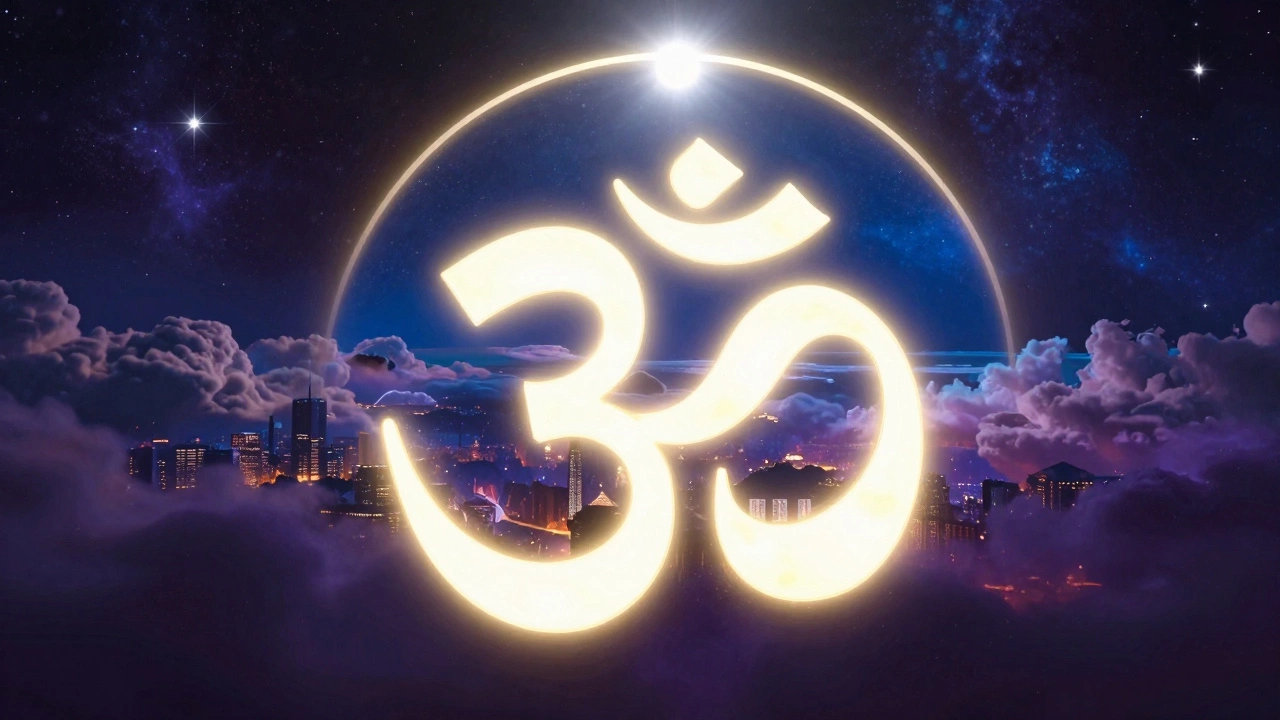
At first glance, the Om symbol looks like a stylized number three with a tail and a dot. However, every curve is a specific piece of a puzzle explaining how we experience life. The large lower curve represents the waking state (Jagrat), where we experience the world through our five senses. It is the most dominant part of the symbol because most of our time is spent in this conscious, external reality.
The middle curve, tucked in the center, symbolizes the dream state (Svapna). This is where we are conscious of our inner world-our thoughts, memories, and imaginations-while our physical body rests. Then there is the upper curve, representing the state of deep, dreamless sleep (Sushupti). In this phase, the mind is completely at peace, and there is no desire or longing, only a profound sense of unity.
But the real secret lies at the very top. There is a semi-circle and a dot. The semi-circle is called the Maya, which is the veil of illusion that separates us from the truth. The dot above it represents Turiya, the fourth state of consciousness. This is the goal of spiritual life: a state of pure awareness where you realize you are one with the universe. When you look at the symbol, you are essentially looking at a map of the human psyche trying to break through the illusion of the material world to find absolute truth.
The Power of Three: The A-U-M Vibration
While we write it as "Om," the traditional pronunciation is actually Aum. This is crucial because the sound is broken into three distinct vibrations that mirror the structure of the universe. The "A" starts at the back of the throat, the "U" rolls through the mouth, and the "M" closes the lips, creating a humming resonance that vibrates in the skull.
These three sounds are not random. They align perfectly with the Trimurti, the three primary functions of the divine. The "A" represents Brahma, the Creator. The "U" represents Vishnu, the Preserver. The "M" represents Shiva, the Destroyer. By chanting Aum, a practitioner is acknowledging the entire cycle of life-birth, existence, and the eventual return to the source. It is a sonic representation of the law of nature: everything that begins must eventually end to make room for something new.
This phonetic structure is also mirrored in other aspects of Hindu thought. Think about the three Gunas (qualities of nature): Sattva (harmony), Rajas (activity), and Tamas (inertia). Or consider the three realms: Earth, Atmosphere, and Heaven. By condensing all these triplets into one sound, the symbol acts as a universal shorthand for the totality of the cosmos.
| Sound/Part | State of Consciousness | Divine Entity (Trimurti) | Cosmic Function |
|---|---|---|---|
| A | Waking State | Brahma | Creation |
| U | Dream State | Vishnu | Preservation |
| M | Deep Sleep | Shiva | Destruction/Transformation |
| Silence | Turiya (Pure Bliss) | Brahman (The Absolute) | Unity/Oneness |
Where You Will Find Om in Daily Life
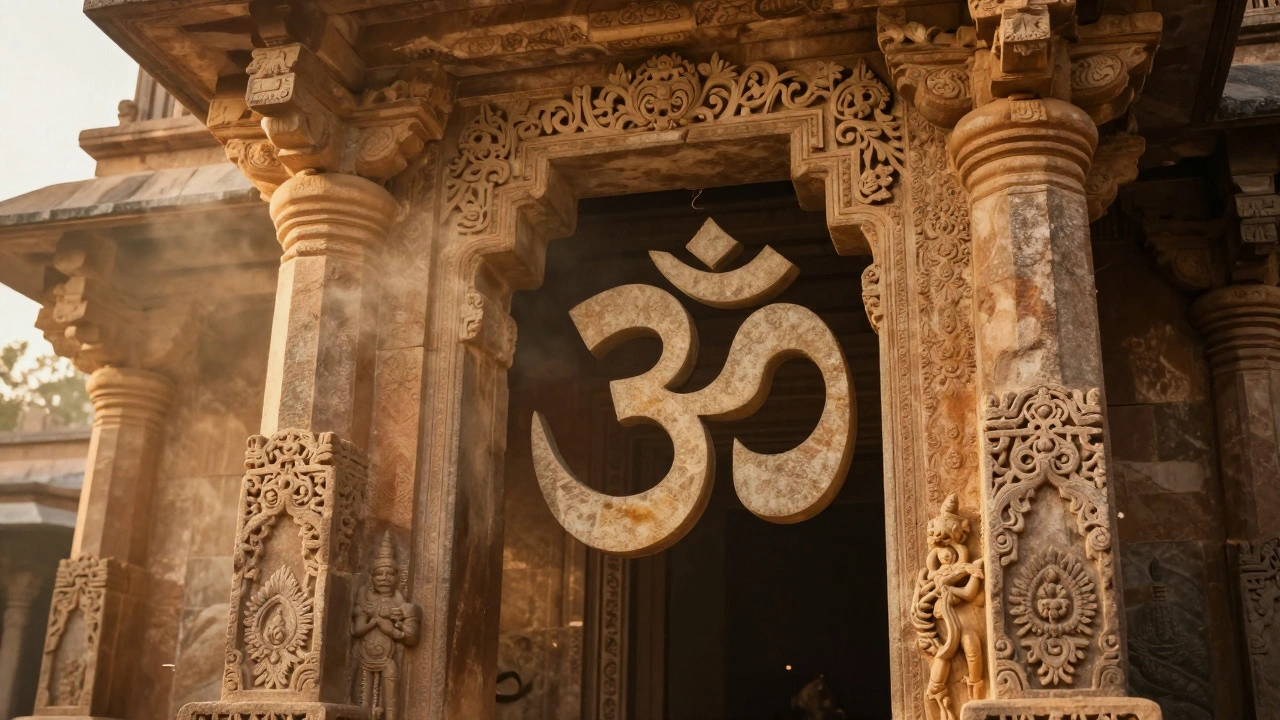
Om isn't just tucked away in dusty old books; it is everywhere in Indian culture. You will see it carved into the entrance of temples to purify the energy of those entering. It is often the first word spoken in a Veda chant or a prayer session. In a traditional puja (worship ritual), starting with Om signals to the mind that it is time to move from the noise of the world into a state of spiritual focus.
Beyond religion, it has become a global symbol for wellness. If you take a Yoga class in New York or London, the teacher will likely lead the group in a collective Om chant. This isn't just for tradition; there is a physical component to it. The vibration of the "M" sound has been noted to stimulate the vagus nerve, which helps lower the heart rate and trigger a relaxation response in the body. It is a bridge between a spiritual belief and a biological reality.
In artistic expressions, the Om symbol is often entwined with the lotus flower, representing purity, or placed atop a pyramid, symbolizing the ascent of the soul. Even in modern jewelry or tattoos, it serves as a reminder to the wearer to stay centered and remember their connection to the larger whole, even amidst the chaos of a busy city.
Other Sacred Symbols That Complement Om
While Om is the "king" of symbols, it doesn't stand alone. To understand the full visual language of Hinduism, you have to look at a few other icons that often appear alongside it. For instance, the Swastika-which in the Indian context is an ancient sign of prosperity and good fortune, completely unrelated to the 20th-century political perversion of the image. It represents the four directions and the movement of the sun.
Then there is the Trishula, the trident of Lord Shiva. While Om represents the sound of the universe, the Trishula represents the power to control the three worlds (physical, ancestral, and spiritual). You will also often see the Sri Yantra, a complex geometric pattern of interlocking triangles. If Om is the sound of the divine, the Sri Yantra is the visual architecture of that same divine energy.
These symbols work together like a language. Om sets the vibration, the Swastika brings the luck, and the Trishula provides the protection. When you see them together in a temple or on a home altar, they aren't just decorations; they are tools designed to shift the vibration of the space and the person within it.

How to Use the Symbol and Sound for Personal Focus
You don't have to be a scholar of Sanskrit to benefit from Om. Many people use it as a simple anchor for mindfulness. If you are feeling overwhelmed, try the "three-stage breath." Inhale deeply, and as you exhale, mentally divide the sound into A... U... M. Feel the A in your belly, the U in your chest, and the M in your head.
A common mistake beginners make is treating Om as a word with a definition. It isn't a word in the way "apple" is a word. It is a frequency. The goal isn't to think about the meaning of the sound, but to feel the vibration. In the Upanishads, these ancient philosophical texts, it is explained that the entire universe is an manifestation of this one vibration. By chanting it, you are essentially tuning your own internal instrument to match the frequency of the cosmos.
If you are using a physical symbol-like a painting or a pendant-the key is placement. In Vastu Shastra (the Indian science of architecture), sacred symbols are placed in specific directions to maximize the flow of positive energy. Placing an Om symbol in the northeast corner of a room is believed to bring mental clarity and spiritual growth, as this is considered the most sacred direction.
Is Om only for Hindus?
While it is the central symbol of Hinduism, Om is also deeply significant in Buddhism, Jainism, and Sikhism. For example, in Tibetan Buddhism, the famous mantra "Om Mani Padme Hum" begins with the sound of Om. Because it represents a universal vibration rather than a specific deity, people of many different backgrounds use it for meditation and peace.
Why is it sometimes spelled Aum?
"Aum" is a more accurate phonetic representation of how the sound is actually produced. It emphasizes the three distinct syllables (A, U, and M) that represent the different states of consciousness and the Trimurti. "Om" is simply the common English transliteration.
Can I use the Om symbol in my home decor?
Yes, but it is respectful to treat it as a sacred object rather than just a decoration. Avoid placing the symbol on the floor or in bathrooms. Placing it at eye level in a quiet area, such as a reading nook or a meditation space, is the most traditional and respectful way to incorporate it into your home.
What does the dot at the top of the symbol mean?
The dot, known as the Bindu, represents the state of Turiya. This is the highest level of consciousness, where one transcends the waking, dreaming, and sleeping states to achieve absolute oneness with the universe. It is the point of ultimate silence and truth.
Does chanting Om really have physical benefits?
Yes. The humming sound (M) creates a vibration in the chest and head that can stimulate the vagus nerve. This helps switch the body from a "fight or flight" mode to a "rest and digest" mode, reducing stress and lowering blood pressure. It is as much a biological exercise as a spiritual one.
Moving Forward: Your Spiritual Journey
Understanding the Om symbol is a great first step, but the real magic happens when you move from observing to experiencing. If you feel drawn to this vibration, you might want to explore the basics of Pranayama (breathwork) or dive into the Bhagavad Gita to see how these concepts of consciousness and unity are played out in a narrative. Whether you treat it as a religious icon or a psychological tool for stress relief, Om offers a way to quiet the noise of the world and listen to the silence within.
For those who want to go deeper, try spending five minutes each morning in total silence. Once your mind settles, introduce a soft Aum chant. Notice where you feel the vibration in your body. Does it stay in the throat, or does it move down to the heart? This simple observation transforms a symbol on a page into a living, breathing experience.