The Great Epics Comparison Tool
When you ask about the two great stories of Hinduism, the answer isn't just a pair of books. It is the foundation of how millions of people understand duty, love, war, and justice. These are the Ramayana and the Mahabharata. Together, they form what scholars call the *Itihasa*-history or "thus indeed it was." They aren't just ancient tales told by grandparents; they are living texts that shape festivals, art, politics, and daily ethics across India and Southeast Asia today.
If you've ever wondered why Lord Rama is called an ideal husband or why Krishna appears as a charioteer in a cosmic battle, these two epics hold the answers. But diving into them can feel overwhelming. The Mahabharata alone is ten times longer than the Iliad and Odyssey combined. So, let's break down exactly what makes these two stories so monumental, how they differ, and why they still matter to us in 2026.
The Ramayana: The Story of Ideal Duty
The Ramayana is an ancient Sanskrit epic attributed to the sage Valmiki, detailing the life of Prince Rama and his quest to rescue his wife Sita from the demon king Ravana.
Think of the Ramayana as the story of perfect order. It’s clean, linear, and focused on the concept of *dharma* (righteousness) when things go wrong. The protagonist, Rama, is often referred to as *Maryada Purushottam*, or the man of perfect boundaries. He doesn't break rules. He follows them, even when it hurts him.
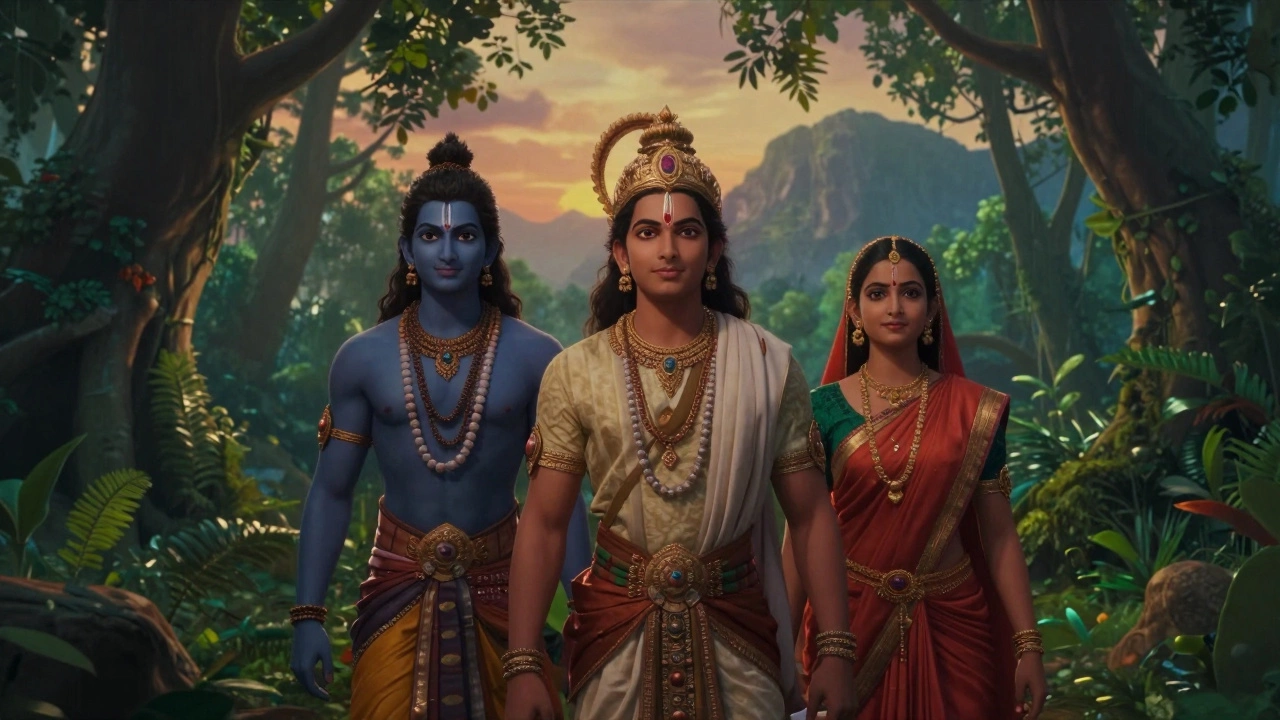
The plot is straightforward but emotionally powerful. Rama, the crown prince of Ayodhya, is exiled to the forest for fourteen years because of a promise his father made to another wife. His wife, Sita, and his loyal brother, Lakshmana, join him. While in exile, Sita is abducted by Ravana, the ten-headed king of Lanka. Rama builds an army of monkeys, led by the devoted Hanuman, crosses the ocean, defeats Ravana, and rescues Sita. They return home to rule with justice.
Why does this story resonate? Because it deals with clear moral lines. Good vs. Evil is distinct here. Ravana represents ego and lust, while Rama represents self-control and duty. For many Hindus, reading the Ramayana is like studying a manual on how to be a good son, husband, king, and citizen. It’s less about complexity and more about clarity.
- Central Theme: Upholding dharma despite personal loss.
- Key Character: Rama (the ideal human).
- Tone: Noble, tragic, yet ultimately triumphant.
- Cultural Impact: Celebrated during Diwali and through the play *Ramlila*.
The Mahabharata: The Complexity of Human Nature
The Mahabharata is the longest epic poem in the world, attributed to the sage Vyasa, chronicling the struggle for power between two sets of cousins, the Pandavas and Kauravas, culminating in the Kurukshetra War.
If the Ramayana is black and white, the Mahabharata is gray. This story doesn’t give you easy answers. It asks hard questions: What if your enemy has a point? What if doing the right thing requires violence? Who is really good, and who is really bad?
The core conflict is a family feud. Two groups of cousins, the Pandavas (five brothers) and the Kauravas (100 brothers), fight for the throne of Hastinapura. The Kauravas, led by Duryodhana, are arrogant and cheat their cousins out of their kingdom. The Pandavas, led by Yudhishthira, are forced into exile. When diplomacy fails, a massive war breaks out at Kurukshetra.
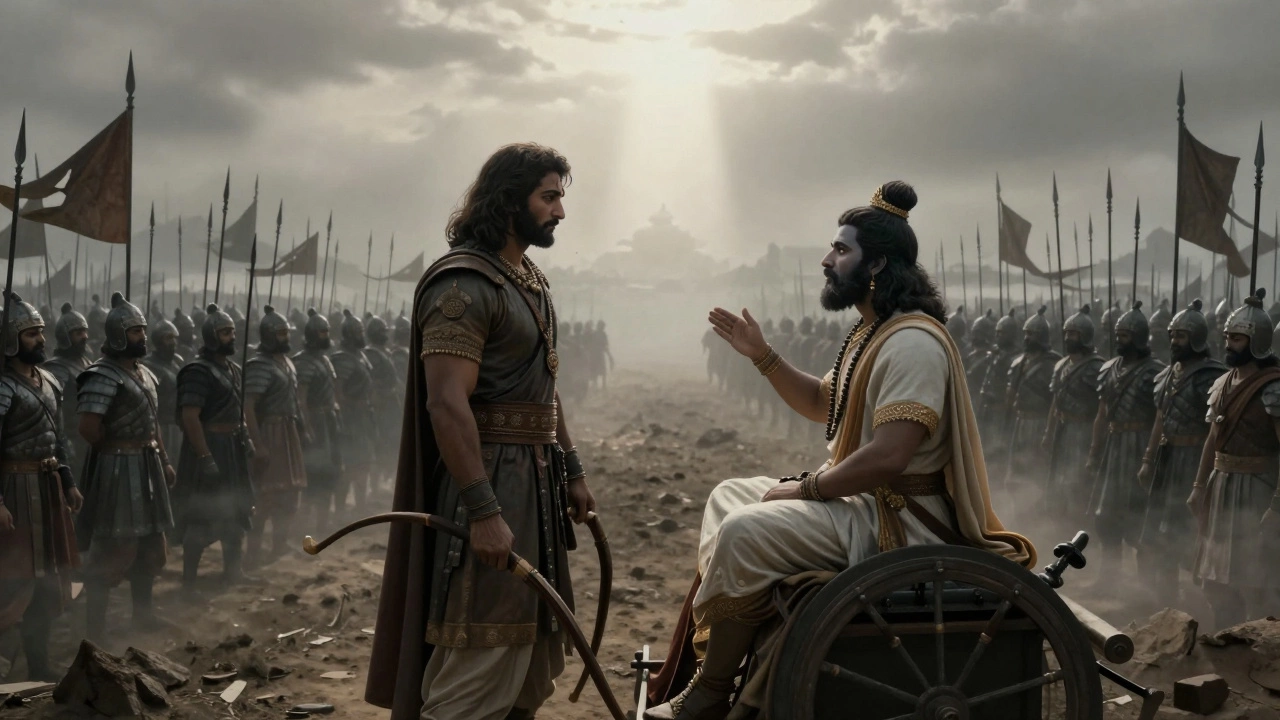
The most famous part of the Mahabharata is the Bhagavad Gita. Just before the battle starts, Arjuna, one of the Pandava warriors, refuses to fight. He sees his relatives, teachers, and friends on the other side. He drops his bow, paralyzed by grief. Then, his charioteer, Krishna (an avatar of Vishnu), delivers a philosophical lecture on duty, action, and devotion. Krishna tells Arjuna that he must fight not for revenge, but because it is his duty as a warrior. This moment is the spiritual heart of Hinduism for many.
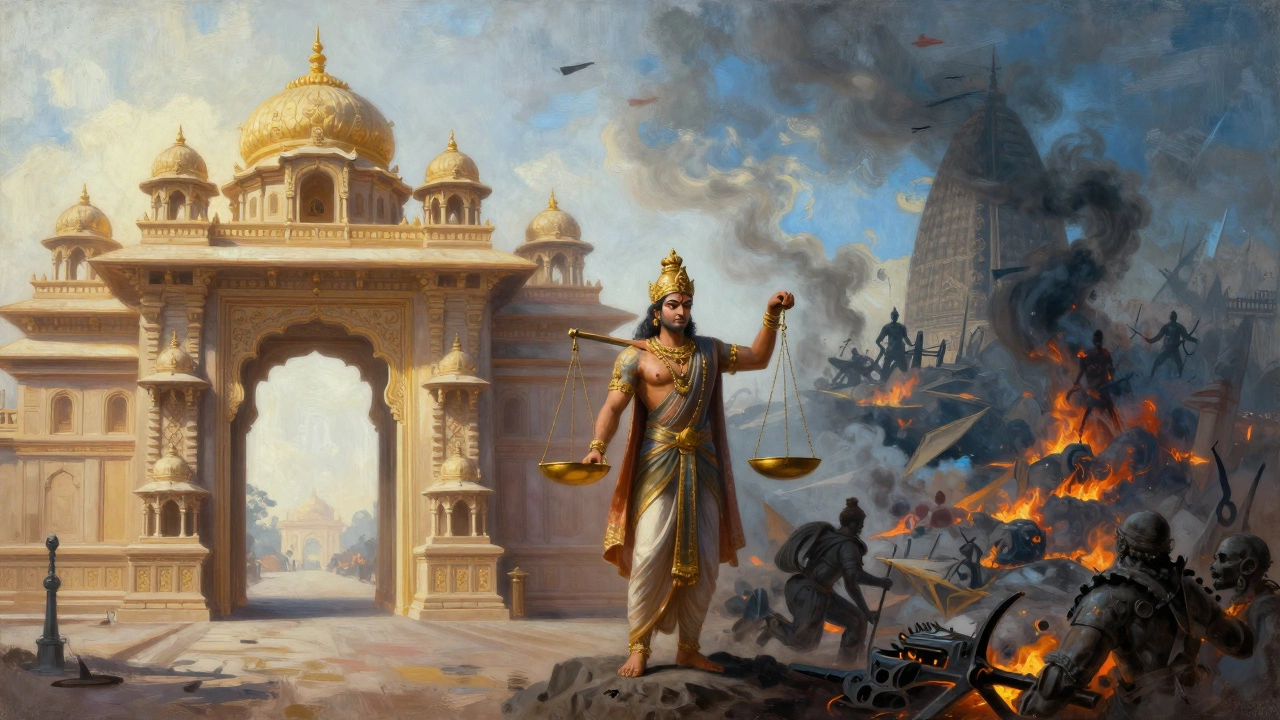
In the end, the Pandavas win, but the victory is hollow. Almost everyone they loved dies in the war. The story ends with a sense of exhaustion, not joy. It teaches us that maintaining order in a chaotic world often comes at a terrible cost.
- Central Theme: The ambiguity of morality and the inevitability of change.
- Key Character: Krishna (the divine guide) and Arjuna (the confused hero).
- Tone: Complex, psychological, and tragic.
- Cultural Impact: Source of the Bhagavad Gita; influences political philosophy and ethics.
Comparing the Two Epics: Order vs. Chaos
To truly understand these stories, you have to see how they contrast. They are two sides of the same coin. One shows you how society should work; the other shows you how society actually works.
| Feature | Ramayana | Mahabharata |
|---|---|---|
| Author | Valmiki | Vyasa |
| Length | ~24,000 verses | ~100,000+ verses |
| Main Conflict | External (Man vs. Demon) | Internal & External (Family Civil War) |
| Moral Clarity | High (Good clearly beats Evil) | Low (Gray areas everywhere) |
| Divine Presence | Rama acts as a human first | Krishna reveals his divine form openly |
| Ending | Restoration of order (Rajya) | Exhaustion and transition to Kali Yuga |
Notice the difference in the endings? In the Ramayana, Rama returns to Ayodhya and establishes a golden age. Everything is fixed. In the Mahabharata, the Pandavas win but leave the throne shortly after, realizing that the world is too broken to rule happily. This reflects the Hindu belief in cycles of time (*Yugas*). We are currently in the Kali Yuga, the age of darkness, which began after the Mahabharata war. That’s why the Mahabharata feels so relevant to our modern, messy world.
Why These Stories Matter Today
You might wonder, "Why do I need to know this in 2026?" The answer is simple: these stories provide a framework for decision-making.
The Ramayana offers a model for leadership. Think about Hanuman. He wasn't the strongest or the smartest, but he was the most devoted and humble. Companies and teams study Hanuman’s loyalty and service. Rama’s willingness to accept exile to keep his father’s word is studied in business ethics as integrity over profit.
The Mahabharata, on the other hand, is a guide for navigating complex relationships. Have you ever been in a situation where both sides were right, but neither was fully correct? That’s the Kaurava-Pandava dynamic. It teaches empathy. Even Duryodhana, the villain, had moments of generosity and logic. Understanding that villains have motivations helps us deal with difficult people in real life without losing our own balance.
Moreover, these epics are not static. Every region in India has its own version. In Tamil Nadu, the Ramayana focuses heavily on Sita’s perspective. In Bengal, the Mahabharata is interpreted through a lens of local folklore. This adaptability keeps the stories alive. They aren't museum pieces; they are conversations that continue every day.
How to Start Reading Them
If you want to dive in, don't start with the original Sanskrit translations unless you're a scholar. They are dense and repetitive. Instead, look for modern retellings.
- For Beginners: Try C. Rajagopalachari’s versions. He wrote them specifically for young readers, keeping the language simple and the plots tight.
- For Depth: Read J.D. Vaidya’s translation of the Mahabharata. It’s scholarly but accessible.
- For Modern Perspective: Look up Amish Tripathi’s *Scindia Series* or Chitra Banerjee Divakaruni’s *The Palace of Illusions*. These are fictionalized retellings that focus on character psychology rather than just plot.
- Watch Visuals: The 1980s TV series *Ramayan* and *Mahabharat* directed by Ramanand Sagar and B.R. Chopra, respectively, are cultural landmarks in India. They are available online and help visualize the characters.
Start with the Bhagavad Gita if the Mahabharata feels too long. It’s only 700 verses and contains the essence of the entire epic’s philosophy. You can read it in an afternoon and gain a lifetime of insight.
Common Misconceptions About These Epics
There are a few myths surrounding these stories that we should clear up.
Myth 1: They are religious dogma. While deeply spiritual, these epics are also literature. They contain humor, satire, and political intrigue. Vyasa, the author of the Mahabharata, famously said, "If something is found here, it is true. If something is not found here, it is false." This implies the text is a mirror of reality, not just a set of rules.
Myth 2: Rama and Krishna are the same person. They are both avatars of Vishnu, but they represent different aspects of divinity. Rama is the ideal man who struggles within human limits. Krishna is the divine who plays games with humans. One is about restraint; the other is about liberation.
Myth 3: The women are weak. This is a common critique, but a closer look reveals strong female figures. Sita chooses to go into exile voluntarily. Draupadi, the wife of the Pandavas, challenges the gods and the elders in court when her honor is insulted. Her question-"Who is my husband first?"-is a legal and philosophical puzzle that halts the entire narrative. These women drive the plot, not just react to it.
Conclusion: Choosing Your Path
So, which one should you explore first? If you crave clarity and inspiration, start with the Ramayana. It will lift your spirit. If you are ready to confront the messiness of life and find wisdom in chaos, pick up the Mahabharata. It will challenge your mind.
Both stories teach us that life is a battlefield, whether literal or metaphorical. The goal isn't necessarily to win without scars, but to fight with integrity. Whether you follow Rama’s path of strict duty or Krishna’s path of detached action, the message remains the same: stay true to your dharma, no matter what happens around you.
Are the Ramayana and Mahabharata historical facts?
Scholars debate this extensively. Most historians view them as mytho-historical texts, meaning they may be based on real events or people but have been embellished over centuries with divine elements. Archaeological evidence for specific sites like Ayodhya or Kurukshetra exists, but the supernatural events (like flying palaces or multi-armed gods) are considered symbolic or allegorical rather than literal history.
Which epic is older?
The Ramayana is generally considered older, dating back to between 500 BCE and 100 CE. The Mahabharata evolved over a longer period, with its core likely composed around 400 BCE to 400 CE. However, both texts underwent significant revisions and additions over many centuries before reaching their current forms.
What is the Bhagavad Gita?
The Bhagavad Gita is a 700-verse dialogue between Prince Arjuna and Lord Krishna that takes place within the Mahabharata. It is often treated as a standalone scripture because it summarizes key Hindu philosophical concepts, including karma (action), bhakti (devotion), and jnana (knowledge). It is one of the most translated and read texts in the world.
Can non-Hindus enjoy these stories?
Absolutely. Like Shakespeare or Homer, these epics are universal literature. They deal with human emotions, family conflicts, leadership dilemmas, and ethical choices that transcend religion. Many non-Hindus appreciate them for their literary beauty, philosophical depth, and complex character development.
Why is Hanuman so popular?
Hanuman represents strength combined with humility and devotion. Unlike Rama, who is a prince and distant, Hanuman is seen as accessible and helpful. He jumped across the ocean to help someone else without expecting anything in return. This selfless service (*seva*) resonates deeply with people from all walks of life, making him one of the most worshipped deities in India today.