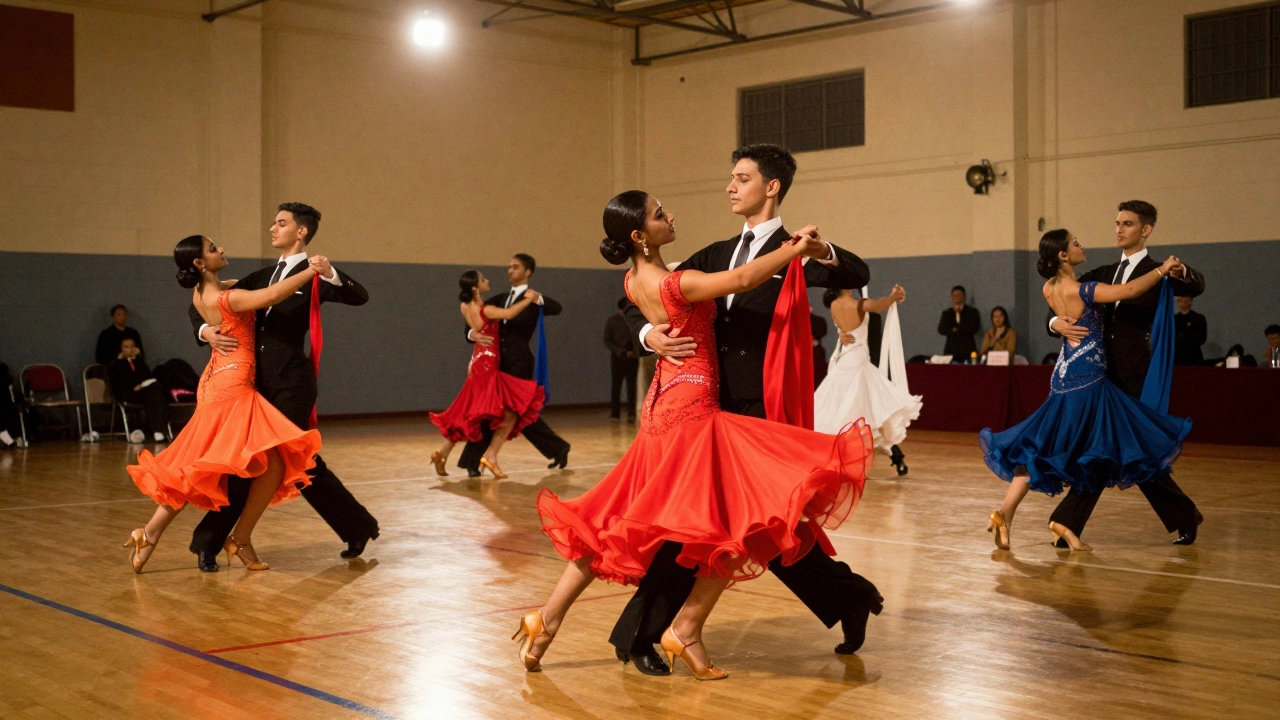
High School Dance Style Selector
Select a dance style below to see its characteristics, best use cases, and common mistakes based on high school curricula.
Ballroom
Waltz & Foxtrot
Latin
Cha-Cha & Samba
Swing
Jitterbug & Lindy Hop
Ballroom: The Foundation of Partner Dancing
Includes Waltz and Foxtrot
Key Characteristics
- Closed hold (partners connected)
- Smooth, flowing movements
- Focus on posture and frame
Best For
Slow songs, formal events like proms, and learning basic dance etiquette.
Picture this: It’s Friday night. The gymnasium smells faintly of floor wax and nervous sweat. The lights dim, a beat drops, and suddenly everyone is looking at you. You’ve been asked to dance. But what do you actually do? For most students, the answer isn’t one specific move-it’s one of three main styles that dominate the high school social scene. Whether you are heading to a formal prom, a casual pep rally, or just trying to survive a homecoming date, understanding these three pillars-Ballroom, Latin, and Swing-can save you from awkward standing around.
The question "What are the three dances in high school?" usually refers to the three primary categories taught in school dance programs or seen on the dance floor: Ballroom, which includes Waltz and Foxtrot; Latin, featuring Cha-Cha and Samba; and Swing, covering Jitterbug and Lindy Hop. These aren't just random moves; they represent distinct rhythms, partner connections, and cultural histories that have shaped how teenagers interact socially for decades.
1. Ballroom: The Foundation of Partner Dancing
When people think of "formal" dancing, they usually picture Ballroom. This style is the backbone of most high school dance curricula because it teaches structure, posture, and lead-and-follow techniques. If you have ever taken a PE class that included dancing, you likely started here.
Waltz is the quintessential ballroom dance characterized by its smooth, gliding movements and 3/4 time signature. It requires a closed hold, where partners stand close together, rotating around the room. The challenge for beginners isn't the steps-it's the timing. Waltz demands a strong "ONE-two-three" count. Many students struggle because they rush the rise and fall, making the movement look jerky instead of flowing. To master it, focus on lifting through your ankles and knees on the first step, then sinking slightly on two and three.
Another staple is Foxtrot is a smooth, progressive ballroom dance danced in 4/4 time with long, sustained movements. Unlike Waltz, Foxtrot doesn't rotate as much; it travels across the floor. It feels more like walking gracefully than spinning. In high school settings, Foxtrot is often used for slower songs at proms. It’s less intimidating than Waltz because the tempo is steady, but it requires excellent frame control. If your shoulders collapse, the connection breaks, and you end up bumping into your partner.
- Key Attribute: Closed hold (partners connected).
- Best For: Slow songs, formal events, learning basic etiquette.
- Common Mistake: Stiff arms or holding breath while turning.
2. Latin: Energy, Rhythm, and Individual Expression
If Ballroom is about smoothness, Latin dance is about energy. This category brings heat, speed, and intricate footwork to the high school dance floor. While Ballroom keeps partners locked in a frame, Latin dances often allow for open positions, giving each dancer more space to express themselves individually.
Cha-Cha is a playful Latin dance with a crisp, staccato rhythm and distinctive triple-step action. The name comes from the sound of the shuffling feet: "cha-cha-cha." It’s incredibly popular in schools because it’s fast-paced and fun. The basic step involves locking the feet together twice before stepping out. It looks simple, but doing it without looking like you’re marching requires hip isolation. Students often try to force the hip movement, which leads to injury. Instead, let the weight transfer naturally create the motion.
Then there’s Samba is a Brazilian dance known for its bouncing action and rhythmic bounce derived from the legs rather than the knees. Samba is all about that bounce. It’s not about jumping up and down; it’s about compressing and releasing the leg muscles. In a high school context, Samba might appear during cultural festivals or themed dances. It requires a lot of stamina. If you haven’t warmed up, your calves will scream after thirty seconds. The key is to keep your upper body relaxed while your lower body does the work.
| Feature | Ballroom (Waltz/Foxtrot) | Latin (Cha-Cha/Samba) |
|---|---|---|
| Hold Style | Closed hold, continuous contact | Open position, intermittent contact |
| Rhythm | Smooth, flowing, sustained | Staccato, percussive, sharp |
| Movement Focus | Upper body frame, rotation | Hip action, footwork, bounce |
| Social Vibe | Elegant, formal, reserved | Playful, energetic, expressive |
3. Swing: The Social Connector
The third pillar is Swing, and this is where things get loose. Swing dances originated in the jazz age and are designed for social interaction. Unlike Ballroom, which can feel rigid, Swing encourages improvisation. It’s the dance you see when the DJ plays an upbeat classic rock or pop song with a backbeat.
Jitterbug is a fast-paced swing dance style characterized by quick footwork, kicks, and spins, often danced to upbeat music. In high schools, Jitterbug is often synonymous with "swing dancing." It’s less about perfect technique and more about keeping up with the energy. The basic step is a six-count pattern: rock forward, step back, kick-step, step back, kick-step. It allows for lots of turns and tricks. Because it’s faster, mistakes happen quickly. The best advice? Keep your hands light. If you grip your partner’s hand too tightly, you’ll pull them off balance when you spin.
Lindy Hop is an African-American dance created in Harlem in the 1920s, known for its acrobatic lifts and joyful spirit. While full Lindy Hop might be too complex for a typical gym class, elements of it bleed into general swing dancing. It emphasizes connection and reaction. You don’t plan every move; you react to your partner’s lead. This makes it ideal for mixed-skill groups. One person might know five moves, the other only two, but if they listen to each other, they can dance together seamlessly.
- Listen to the Music: Swing has a distinct "oom-pah" or backbeat. Step on the strong beats.
- Stay Loose: Tension kills swing. Relax your shoulders and elbows.
- Protect Your Partner: Never force a turn. If they resist, stop and reset.
Why These Three Matter in School Settings
You might wonder why schools stick to these three. It’s not just tradition. Each style teaches different social skills. Ballroom teaches respect and spatial awareness. Latin teaches confidence and individual expression within a partnership. Swing teaches adaptability and communication.
In many districts, dance is part of the physical education curriculum. Teachers use these three styles because they cover a wide range of musical tempos and cultural backgrounds. A student who struggles with the precision of Waltz might thrive in the freestyle nature of Swing. By exposing students to all three, schools ensure that everyone finds a way to connect with the music and their peers.
Moreover, these dances are versatile. The same basic steps from Cha-Cha can be adapted to modern pop songs if you strip away the strict timing. The frame from Foxtrot works for slow jams at prom. Understanding the mechanics gives you the freedom to improvise later. You’re not just memorizing steps; you’re learning a language of movement.
Tips for Surviving Your First Dance
If you’re heading to a dance and feel unprepared, remember these practical tips. First, wear comfortable shoes. High heels on a polished gym floor are a recipe for disaster. Flat-soled shoes with some grip are best. Second, hydrate. Dancing is cardio. You’ll sweat more than you expect. Third, start slow. Don’t try to impress anyone with complex turns on the first song. Stick to the basic step until you find your rhythm.
Finally, communicate with your partner. A simple "Is this okay?" or "Let’s try again" goes a long way. Most people are just as nervous as you are. Being kind and patient makes you a better dancer than any fancy move ever could.
What is the most common dance taught in high school?
The most common dance taught is usually the Waltz, as it serves as the foundation for partner dancing. It introduces students to the concept of lead and follow, proper frame, and basic timing in a structured environment.
Do I need a partner to learn these dances?
While having a partner helps practice lead-and-follow dynamics, you can learn the footwork and styling solo. Many instructors teach basics without partners initially, allowing students to focus on their own movement before adding complexity.
Can I mix these dance styles?
Yes, especially in social settings. Modern social dancing often blends elements of Swing and Latin. However, in formal competitions or exams, sticking to the specific rules of each style is required for scoring.
What should I wear to a high school dance?
Comfort is key. Wear clothes that allow movement. Avoid long skirts that might trip you or tight jeans that restrict bending. Shoes should have non-marking soles and provide good support. For formal dances, dress codes apply, but prioritize footwear safety.
How do I ask someone to dance?
Be direct and polite. Make eye contact, smile, and simply ask, "Would you like to dance?" If they say no, accept it gracefully. Rejection is normal and not personal. Always thank your partner after the dance.