When you think of Tamil Nadu, you don’t just think of temples or spicy food. You think of a place where culture isn’t something you visit-it’s something you breathe. From the early morning chants in a village temple to the rhythmic clatter of ankle bells during a Bharatanatyam performance, Tamil Nadu’s culture is alive in every corner, every gesture, every meal. It’s not preserved behind glass like a museum exhibit. It’s lived, passed down, and reinvented by millions every single day.
Roots That Run Deep
The culture of Tamil Nadu isn’t something that started a few centuries ago. It stretches back over two thousand years, to the Sangam period, when poets wrote about love, war, and the sea in a language still spoken today. Tamil is one of the oldest living languages in the world, and its literature predates much of Western classical writing. This isn’t just history-it’s identity. People here don’t say they’re proud of their language. They say, “Tamil is my soul.”
That pride shows in everyday life. You’ll hear Tamil spoken in markets, on buses, in schools, and even in tech hubs like Chennai. Unlike other parts of India where English or Hindi dominate urban spaces, Tamil Nadu holds firm. Street signs, government forms, school textbooks-all in Tamil. It’s not resistance. It’s continuity.
Festivals That Move the Whole State
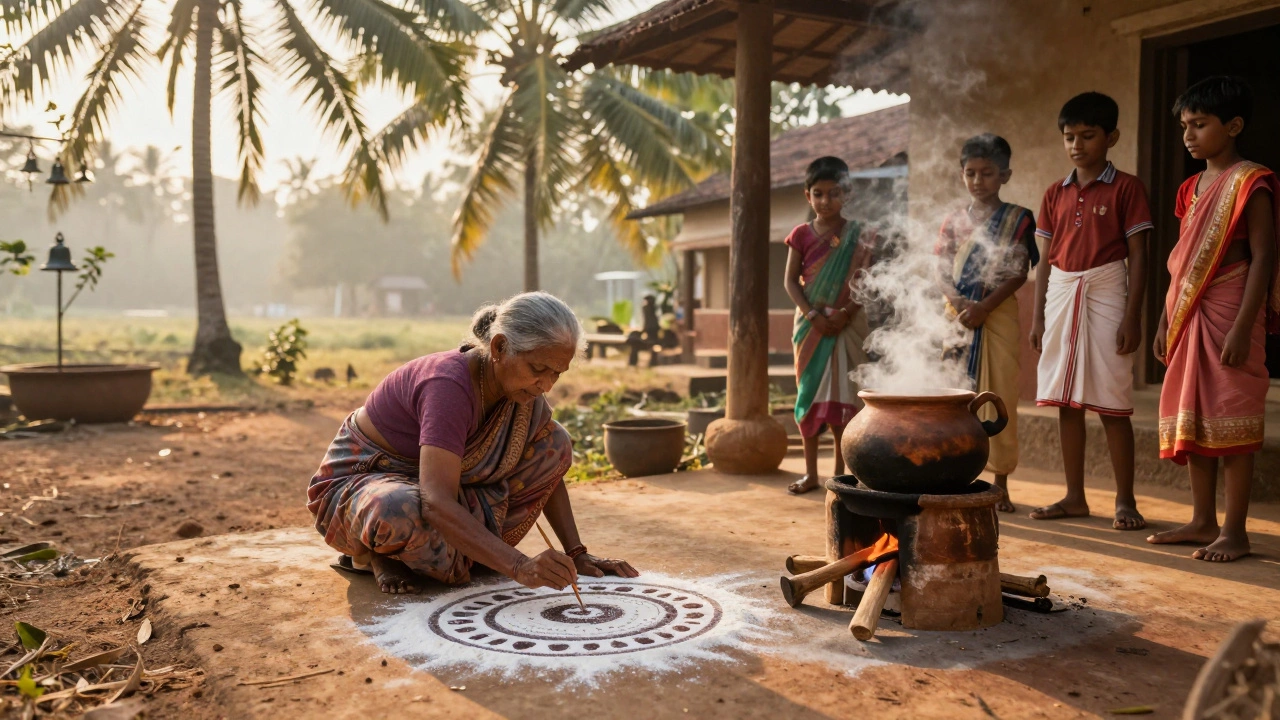
If you want to understand Tamil Nadu’s culture, attend Pongal. It’s not just a harvest festival. It’s a four-day celebration where every family wakes up before sunrise to cook a sweet rice dish in clay pots, letting it boil over as a sign of abundance. The first portion is offered to the sun, then to cows, then to family. No one rushes it. No one skips it. It’s ritual, yes-but also joy.
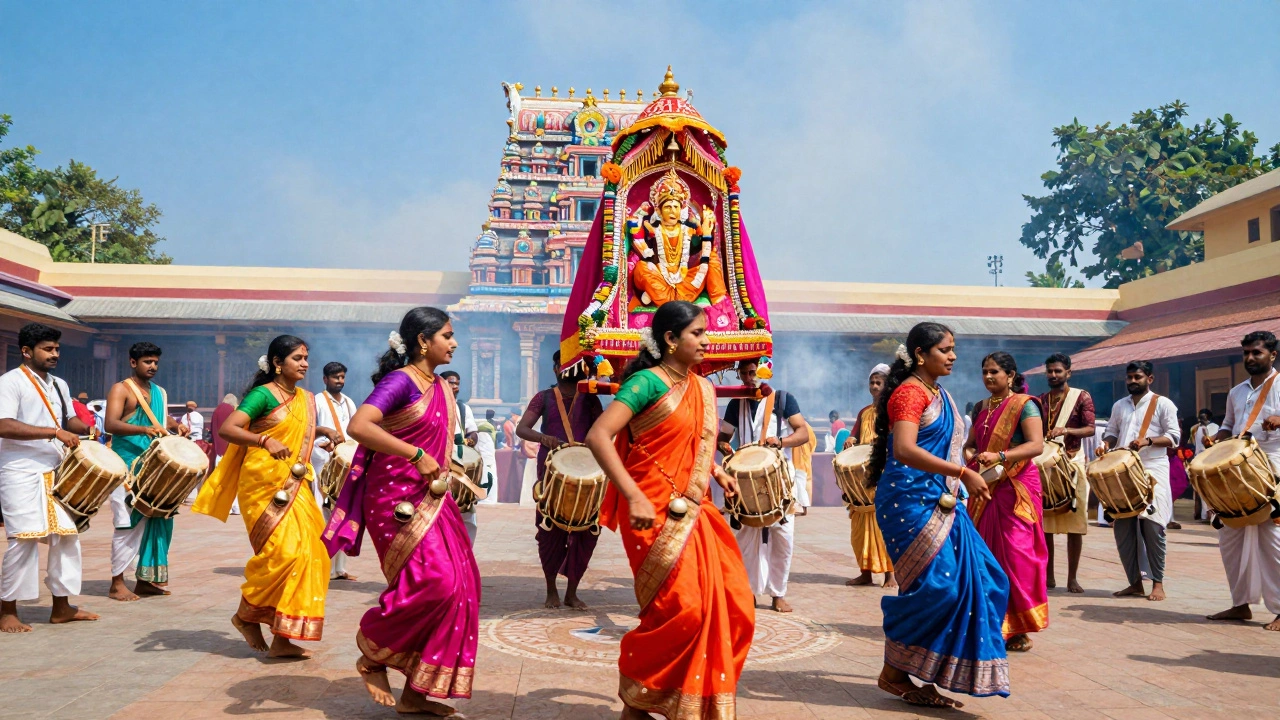
Then there’s Mariamman Thirukkalyanam, a festival where the goddess of rain is married in grand processions across rural towns. People carry ornate palanquins, drummers play for hours, and women in silk sarees dance barefoot around temple courtyards. These aren’t performances for tourists. They’re acts of devotion, passed from mother to daughter for generations.
Even Diwali here feels different. While other states light lamps for prosperity, Tamil Nadu celebrates with oil baths at dawn, followed by new clothes and sweet rice cakes. The timing? It’s often held a day earlier than in the north. Why? Because tradition here doesn’t follow a calendar-it follows lineage.
Art That Breathes
Walk into any home in Madurai or Thanjavur, and you’ll likely see a Kolam-a delicate geometric pattern drawn daily at the doorstep using rice flour. It’s not decoration. It’s prayer. It’s also science: the patterns are mathematically precise, often reflecting fractal geometry found in nature. Children learn to draw them before they learn multiplication.
And then there’s Bharatanatyam. This isn’t just dance. It’s storytelling through movement, gesture, and expression. A single hand motion can mean a bird in flight, a lover’s sigh, or a god’s wrath. Dancers train for over a decade just to master the basics. The music? Carnatic classical-complex, layered, and rooted in ancient ragas that have changed little in 500 years.
Temple art here isn’t just carved stone. It’s alive. The bronze statues of Shiva as Nataraja, the cosmic dancer, aren’t relics. They’re still used in rituals. In Chidambaram, the idol is carried through the streets every year. People touch it. They weep. They believe it’s still breathing.
Food: More Than Spice
Tamil Nadu’s food doesn’t shout. It whispers. It’s not about heat-it’s about balance. A typical meal isn’t just rice and curry. It’s a sequence: a spoonful of tamarind rice, a dab of coconut chutney, a bite of pickled mango, a spoon of yogurt, and finally, a piece of jaggery. Each flavor has a role. Each step has meaning.
Breakfast? Idli and sambar. But not just any idli. The batter ferments overnight in earthen pots. The sambar? Made with lentils, tamarind, and over a dozen spices-no two households use the same mix. Every grandmother has her own version, and no one dares to change it.
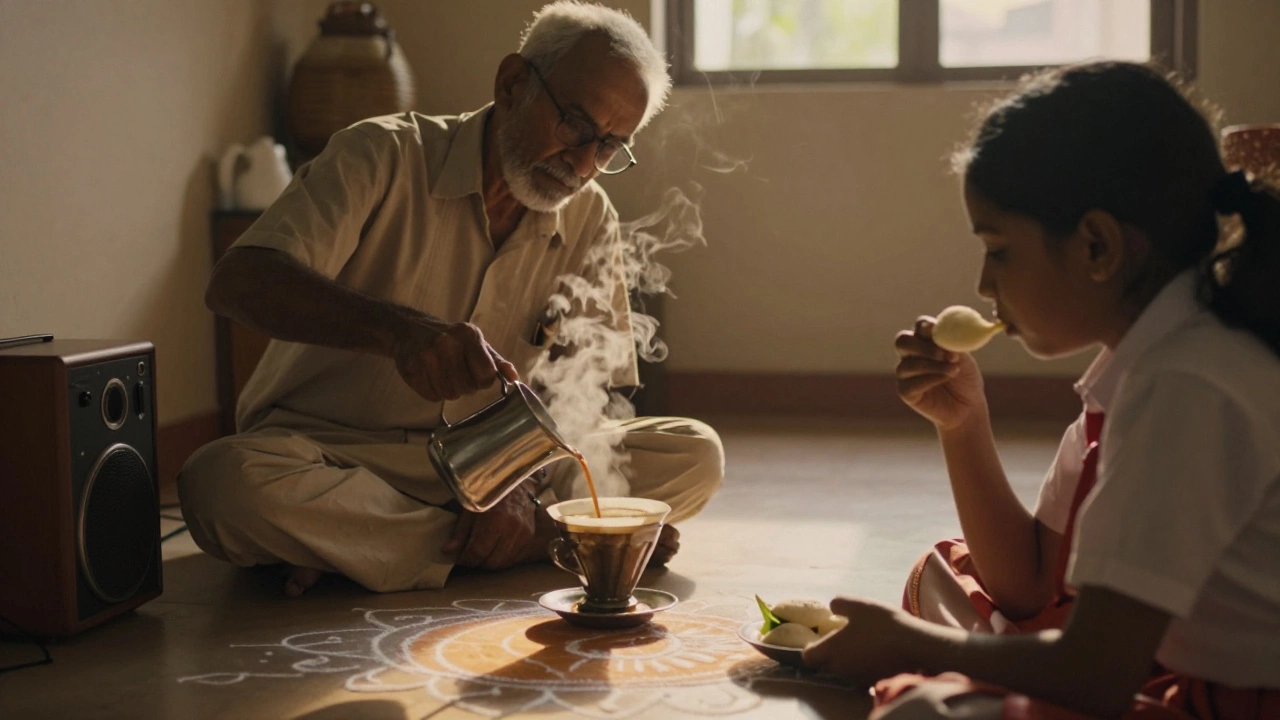
And then there’s filter coffee. Thick, strong, and served in a stainless steel tumbler and dabara. It’s not a drink. It’s a ritual. You pour it from a height to cool it, then sip slowly while the morning sun creeps through the window. Tourists try to copy it. Locals just smile. You can’t replicate the rhythm.
Family, Community, and Quiet Rituals
In Tamil Nadu, family isn’t just your parents and siblings. It’s your aunt’s cousin’s son, your neighbor’s grandmother, the tea vendor who knows your name. People don’t just live near each other-they live for each other.
When someone falls ill, neighbors bring homemade rasam. When a child is born, the whole street decorates the doorway with flowers and rangoli. Weddings aren’t events. They’re weeks-long affairs where every relative, even distant ones, contributes something-a song, a dish, a prayer.
Even death is handled with quiet dignity. Cremation happens by the river, and the ashes are scattered where the water meets the sea. No fancy caskets. No funeral homes. Just tradition, carried out by sons and daughters who know exactly what to do.
Why This Culture Still Thrives
Modern Tamil Nadu has IT parks, shopping malls, and high-speed trains. But none of that erased its soul. Why? Because culture here isn’t about nostalgia. It’s about belonging.
Young people in Coimbatore still learn Carnatic music alongside coding. Girls in Tirunelveli practice Bharatanatyam before school. Farmers in Kanyakumari draw Kolams before heading to the fields. The old ways aren’t being preserved-they’re being lived.
And that’s the secret. Tamil Nadu’s culture doesn’t survive because people think it’s beautiful. It survives because it gives them something no app, no algorithm, no global trend ever could: a sense of rootedness.
Is Tamil Nadu’s culture different from other parts of India?
Yes, in deep and lasting ways. While many Indian states share religious practices, Tamil Nadu stands out for its linguistic pride, the continuity of ancient art forms like Bharatanatyam and Carnatic music, and the daily practice of rituals like Kolam drawing and oil baths during Diwali. Unlike northern India, where Hindi and English dominate, Tamil Nadu’s public life is centered on Tamil language and traditions that have evolved independently for over two millennia.
What makes Tamil festivals unique?
Tamil festivals are deeply tied to agriculture, nature, and local deities. Pongal, for example, is not just a harvest celebration-it’s a four-day ritual honoring the sun, cattle, and family. Mariamman festivals involve elaborate processions and community dancing that last for days, often centered around healing and rain. Unlike pan-Indian festivals, these are not standardized nationwide; each village may have its own version, passed down orally and practiced exactly as ancestors did.
How is Tamil Nadu’s art different from other Indian classical arts?
Tamil Nadu’s classical arts, especially Bharatanatyam and Carnatic music, are among the most systematized in India. Bharatanatyam’s movements follow the ancient text Natya Shastra but evolved uniquely in the temples of Thanjavur under royal patronage. The music uses a distinct set of ragas and talas, and compositions are often in Tamil, not Sanskrit. Unlike Kathak from the north, which has Persian influences, Tamil Nadu’s art forms remained largely untouched by outside rule, preserving their indigenous structure.
Do people still practice Kolam every day?
Absolutely. In rural and urban homes alike, women and girls draw Kolam before sunrise using rice flour or chalk. It’s a daily spiritual practice-not a decoration. The patterns are believed to invite prosperity and ward off negativity. Even in high-rise apartments in Chennai, you’ll find them drawn on balconies and entryways. Some families have passed down the same design for five generations.
Why is Tamil Nadu’s food considered balanced?
Traditional Tamil meals follow the Ayurvedic principle of balancing six tastes: sweet, sour, salty, bitter, pungent, and astringent. A single plate includes rice (sweet), tamarind curry (sour), pickles (salty and sour), neem flowers (bitter), and jaggery (sweet). This balance isn’t accidental-it’s taught from childhood. Eating without this balance is seen as incomplete, even unhealthy. That’s why even fast-food chains in Tamil Nadu offer traditional meal combinations, not just burgers and fries.
If you ever visit Tamil Nadu, don’t just look. Listen. Watch. Taste. The culture won’t announce itself. It will wait until you’re ready to receive it.