Dance Style Finder: Bharatanatyam vs Kathak
Discover which classical Indian dance style aligns with your preferences. Based on key differences in movement, rhythm, and philosophy described in the article.
Your Dance Style Match
Based on your preferences
Why this matches you:
- Geometric precision and structured movement aligns with your preference for exactness
- Devotional focus connects with your value of spiritual depth
- Strict adherence to traditional form matches your appreciation for established patterns
From the article: "Bharatanatyam is about precision as devotion. Every movement has a meaning, every rhythm a purpose. It's a meditation in motion."
Ever watched a classical Indian dance performance and wondered why two styles that look so different both claim to be ancient? That’s because Bharatanatyam and Kathak, though both part of India’s classical dance heritage, were born in different worlds, shaped by different histories, and speak in different rhythms. They’re not just regional variants-they’re nearly opposite sides of the same coin.
Where They Come From
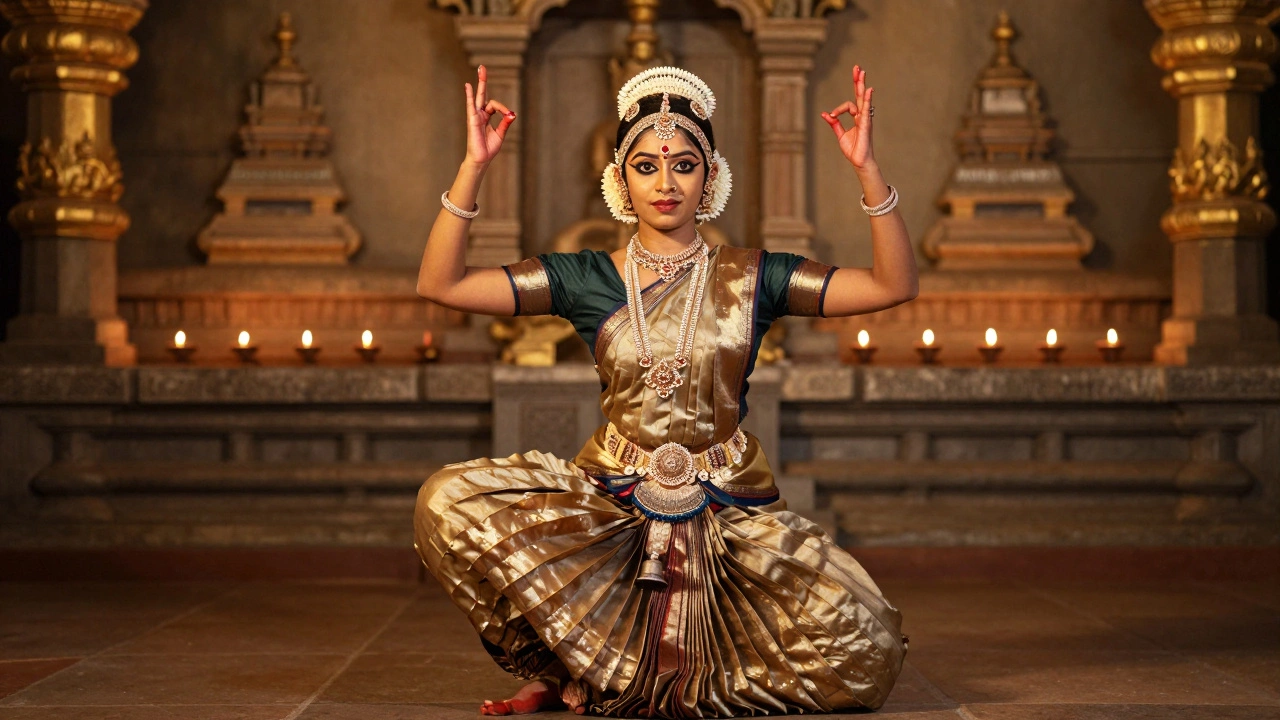
Bharatanatyam started in the temples of Tamil Nadu, in South India. For over 2,000 years, it was performed by devadasis-women dedicated to serving deities through dance. Its movements were precise, spiritual, and meant to tell stories from Hindu epics like the Mahabharata and Ramayana. The dance was a form of worship, not entertainment.
Kathak, on the other hand, began in North India, especially in Uttar Pradesh and Rajasthan. Its roots aren’t in temples but in storytelling. Kathakars-traveling bards-used dance, song, and gesture to recite myths and legends in village squares. Later, during the Mughal era, it moved into royal courts. The focus shifted from devotion to artistry, from ritual to rhythm.
Their Movement Language
Bharatanatyam is built on geometry. Every pose, step, and hand gesture follows strict rules. Dancers stand in a half-sitting posture called aramandi, with knees turned outward and feet planted firmly. The footwork is grounded, deliberate, and often accompanied by the sharp sound of ankle bells hitting the floor in perfect time.
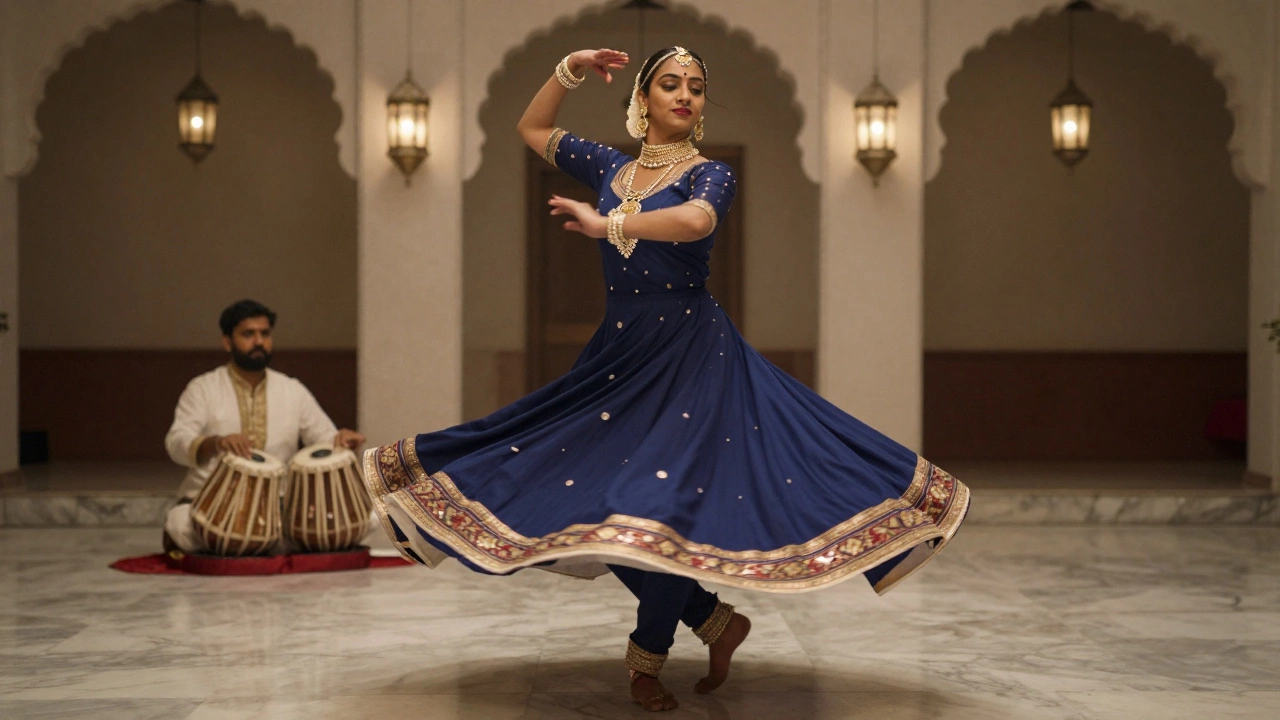
Kathak dancers, by contrast, spin. A lot. One of its most famous features is the chakkars-rapid, controlled spins that can go on for dozens of rotations without losing balance. The posture is upright, elegant, and fluid, with long, flowing movements. The feet glide rather than strike.
In Bharatanatyam, the arms are like sculpted branches-each angle measured, each curve intentional. In Kathak, the arms sweep like wind, carrying emotion more than structure. The hands in Bharatanatyam follow a complex system of mudras (hand gestures) that spell out entire sentences. Kathak uses mudras too, but they’re looser, more expressive, and often blended with facial expressions to convey mood rather than literal meaning.
Rhythm and Music
Bharatanatyam dances to Carnatic music. The rhythm is based on the tala system, with cycles of 7, 8, or 14 beats. The tabla is rarely used. Instead, the dancer’s footwork syncs with the mridangam, a double-headed drum that provides the heartbeat of the performance.
Kathak is built on Hindustani music. The tabla is king here. The dancer doesn’t just follow the rhythm-they play with it. Improvisation is key. A Kathak performer might start a rhythmic pattern, then suddenly shift tempo, challenge the tabla player, or even answer a beat with their foot. This call-and-response between dancer and musician is what makes Kathak feel alive, spontaneous, and thrilling.
There’s a famous saying among dancers: Bharatanatyam is like a temple bell-clear, resonant, and exact. Kathak is like a river-flowing, changing course, always moving.
Costumes and Presentation
Bharatanatyam dancers wear a stitched silk sari draped like a pyjama, with heavy silver jewelry-anklets, bangles, and a headpiece that frames the face. The makeup is dramatic: thick eyeliner, red lips, and a bindi that draws attention to the eyes, which are used to convey emotion with incredible precision.
Kathak dancers wear a long, flowing skirt called a ghagra, paired with a choli (blouse) and dupatta (scarf). The ankle bells are lighter than in Bharatanatyam, and the jewelry is more delicate. The face is less painted, more natural. The focus is on the movement, not the ornamentation.
Performance Structure
A Bharatanatyam recital follows a fixed order: Alarippu (invocation), Jatiswaram (pure dance), Shabdam (narrative with lyrics), Varnam (the centerpiece, mixing rhythm and story), and Padam and Tillana (emotional and rhythmic finale). It’s a structured journey.
Kathak performances are freer. They often begin with a vandana (salutation), then move into thaat (slow, graceful movements), amad (entrance with footwork), jor (building rhythm), jhala (fast, explosive section), and end with a thumri or ghazal (emotional song). The dancer might improvise the entire jor section based on the audience’s reaction.
What They’re Really About
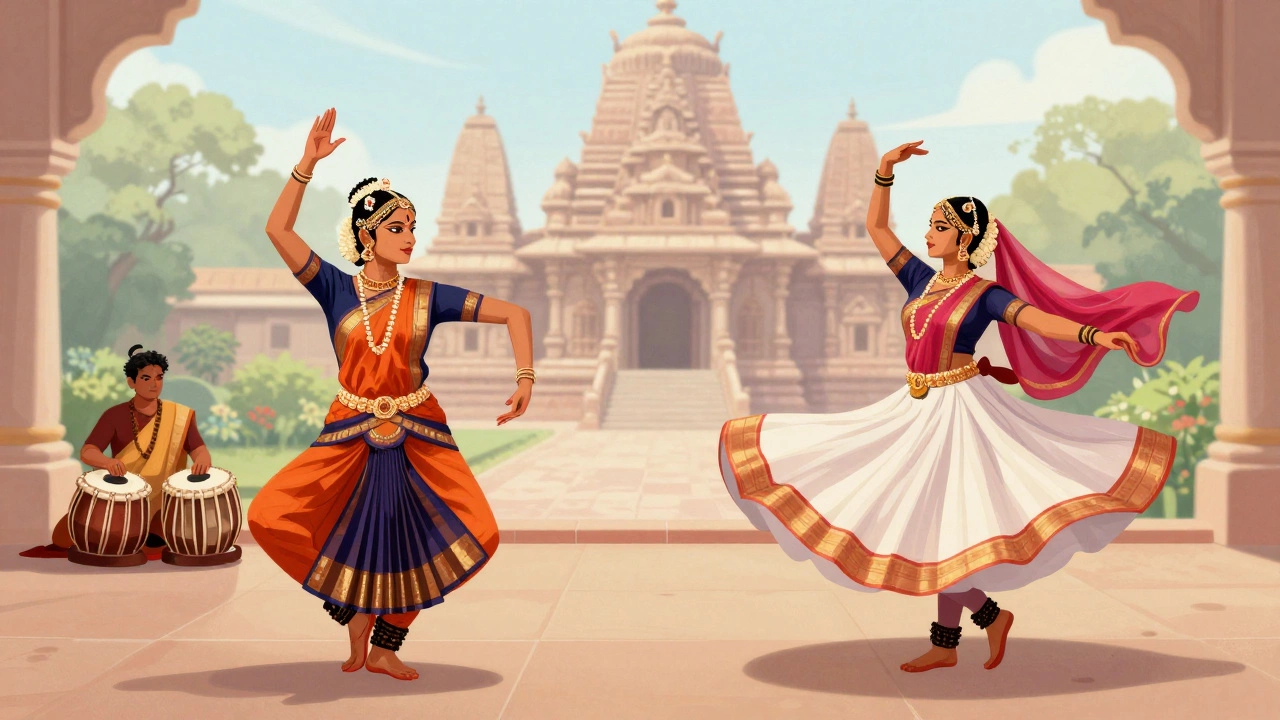
Bharatanatyam is about precision as devotion. Every movement has a meaning, every rhythm a purpose. It’s a meditation in motion. A dancer doesn’t perform to impress-they perform to connect with the divine.
Kathak is about rhythm as conversation. It’s a dance of wit, speed, and surprise. The dancer doesn’t just follow the music-they talk to it, challenge it, dance around it. It’s a dance of human joy, not just divine worship.
One isn’t better than the other. They’re different languages of the same soul. Bharatanatyam speaks in Sanskrit hymns. Kathak speaks in Persian poetry and North Indian folk tales. One is rooted in temple stone. The other in courtly gardens.
Who Practices What Today
Bharatanatyam is still most common in Tamil Nadu, Kerala, and among the Tamil diaspora in Sri Lanka, Singapore, and Malaysia. In the West, it’s often taught in traditional guru-shishya (teacher-student) lineages.
Kathak is dominant in Uttar Pradesh, Delhi, and Rajasthan. It’s also the most popular Indian classical dance in North America and Europe, partly because of its flashy spins and rhythmic complexity. Many modern choreographers blend Kathak with jazz or contemporary dance.
Today, you’ll find dancers from London to Los Angeles learning both styles. But if you ask a Bharatanatyam dancer to do a chakkar, they’ll laugh. And if you ask a Kathak dancer to hold an aramandi for five minutes, they’ll wobble.
Why It Matters
Understanding the difference between Bharatanatyam and Kathak isn’t just about dance-it’s about understanding two paths India took to express the same truths. One held fast to ancient ritual. The other embraced change, fusion, and improvisation. One stayed in the temple. The other walked into the palace, then the theater, then the global stage.
If you’ve ever seen a performance and felt moved, now you know why. It wasn’t just beauty. It was history. It was culture. It was centuries of stories, prayers, and rhythms dancing through time.
Can Bharatanatyam and Kathak be mixed in one performance?
Yes, modern choreographers sometimes blend elements of both, especially in contemporary dance productions. But purists argue that mixing them dilutes their distinct grammar. A true fusion isn’t about combining steps-it’s about understanding the philosophy behind each. Some artists create works where Bharatanatyam’s precision frames a Kathak-style improvisation, creating contrast rather than confusion.
Which dance is harder to learn?
Both are extremely demanding, but in different ways. Bharatanatyam requires years to master the exact body alignment, mudras, and footwork. Mistakes are visible because every angle matters. Kathak demands incredible stamina for spins and complex rhythmic patterns. One tests your control, the other your timing and breath. Many dancers say Bharatanatyam is harder to start, but Kathak is harder to master.
Do both dances use the same footwork technique?
No. Bharatanatyam footwork is based on sharp, percussive strokes with the ball and heel of the foot, designed to match the mridangam’s tone. Kathak uses sliding, gliding steps with more weight on the balls of the feet, creating a lighter, faster sound that matches the tabla. The ankle bells in Kathak are also lighter, allowing quicker, more complex patterns.
Are there any famous dancers who mastered both?
Yes. Padma Shri recipient Shovana Narayan trained in both styles and later created fusion pieces that honored both traditions. Pandit Birju Maharaj, the legendary Kathak maestro, occasionally incorporated Bharatanatyam’s expressive hand gestures into his storytelling. But very few dancers achieve deep mastery in both-each style takes decades to fully internalize.
Is one more popular than the other globally?
Kathak has wider global recognition today, especially in Europe and North America, because its spins and rhythmic play are more visually striking for newcomers. Bharatanatyam is more common in South Asian communities and academic institutions, where its spiritual and technical depth is emphasized. But popularity doesn’t mean superiority-both are equally respected in India.