Bhimbetka Cave Art Quiz
Test your knowledge about India's oldest art form. Based on the article about Bhimbetka cave paintings, answer these questions to see how much you learned!
Results
When you think of Indian art, you might picture intricate temple carvings, colorful Kathakali makeup, or delicate miniature paintings. But none of these came first. The oldest art form in India isn’t found in museums or palaces-it’s carved into the walls of caves deep in the forests of Madhya Pradesh. These aren’t decorations. They’re not religious rituals. They’re stories. And they’re over 30,000 years old.
The Cave Walls That Remembered First
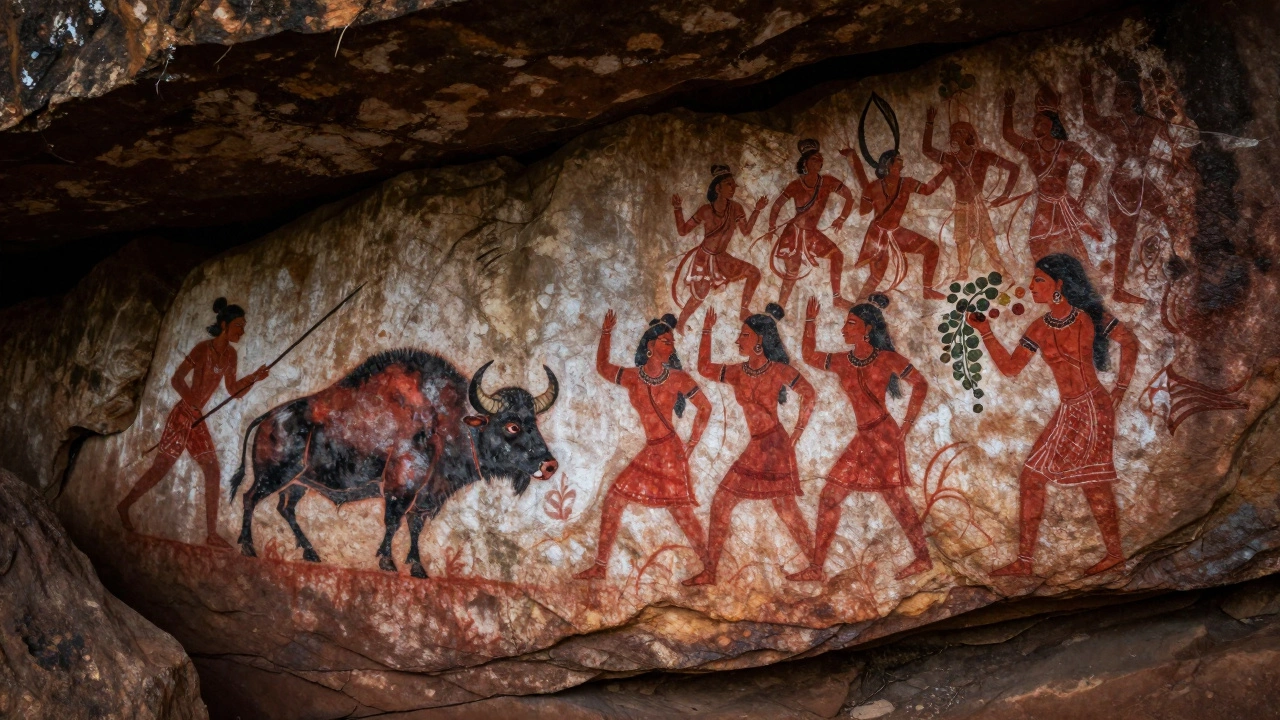
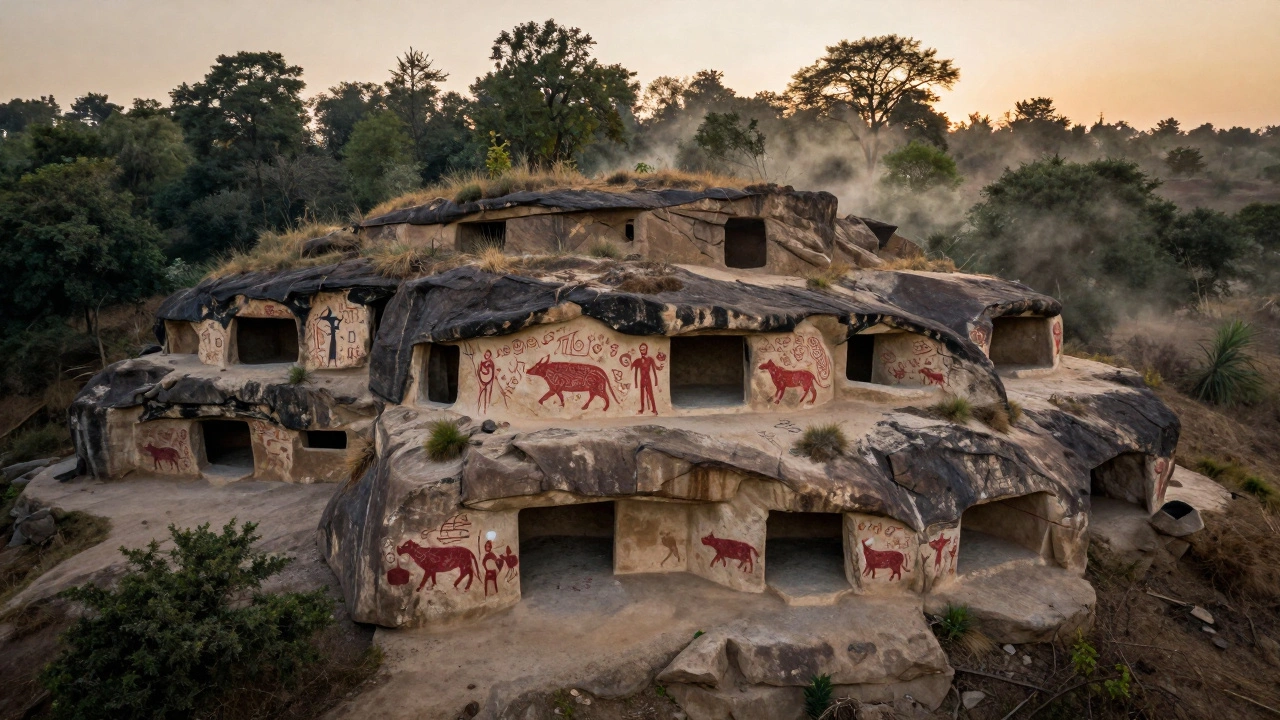
The Bhimbetka rock shelters, tucked into the Vindhya Hills, hold the earliest known artistic expression in India. Discovered in the 1950s by archaeologist V.S. Wakankar, these shelters contain more than 700 painted caves. The paintings aren’t just old-they’re alive. You can see a hunter chasing a bison, a group of dancers moving in rhythm, a woman gathering fruit, even a man playing a drum. These aren’t abstract symbols. They’re snapshots of daily life from a time before writing, before agriculture, before cities.
The pigments used? Nothing fancy. Red ochre from iron-rich soil, white from limestone, black from charcoal, and green from plant matter. Artists mixed them with animal fat or plant sap and applied them with fingers, sticks, or brushes made from animal hair. No brushes from a store. No easels. Just hands, stone, and the raw materials of the earth.
Carbon dating and stylistic analysis confirm these paintings were made between 30,000 and 10,000 years ago. That puts them in the Upper Paleolithic era-older than the pyramids of Egypt, older than Stonehenge, older than the cave art of Lascaux in France. And unlike those European caves, Bhimbetka wasn’t hidden away. It was a living space. People lived here, cooked here, raised children here. The art wasn’t made for gods or elites. It was made by ordinary humans trying to make sense of their world.
Why This Counts as Art
Some might argue: "But this isn’t art. It’s just markings." That’s like saying a child’s drawing isn’t art because it’s not perfect. Art isn’t about skill. It’s about intention. These paintings show deliberate choices: repetition of shapes, balance in composition, movement in posture. One panel shows seven figures in a line, arms raised, legs bent-clearly dancing. Another shows a rhinoceros with exaggerated horns, suggesting the artist wasn’t just copying reality-they were emphasizing what mattered.
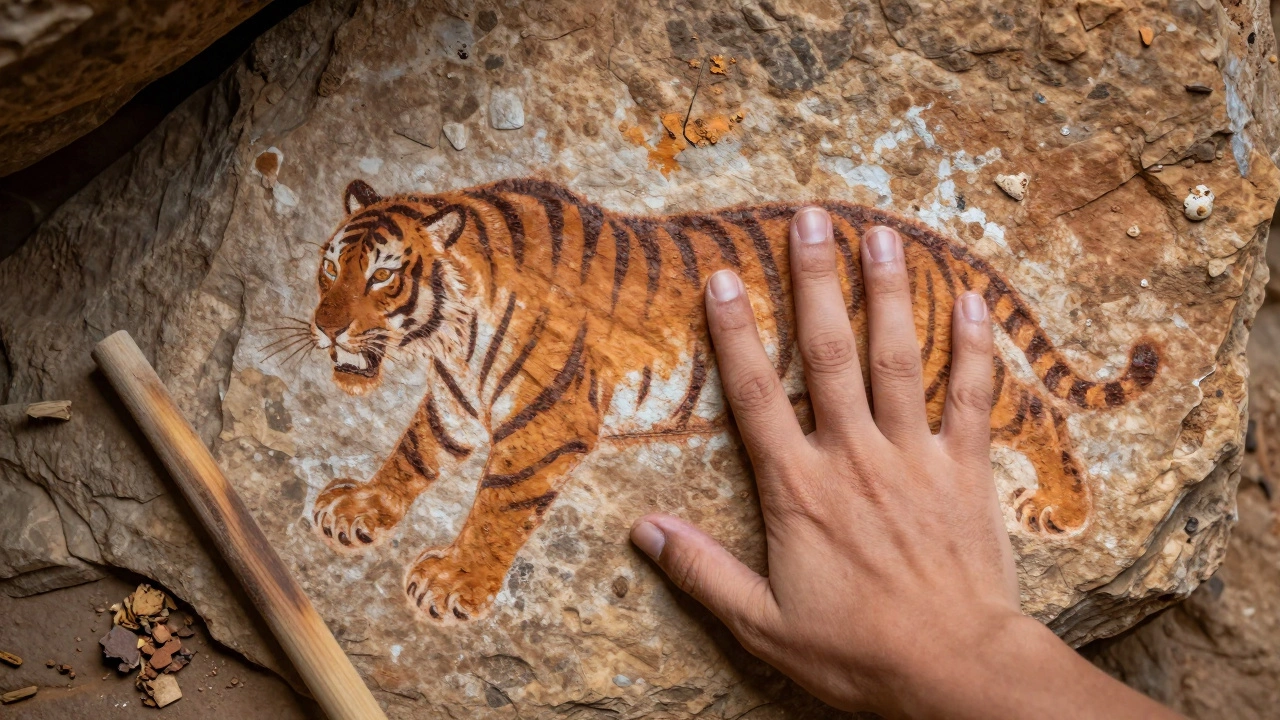
The repetition of certain animals-bison, tigers, elephants-across hundreds of caves suggests shared cultural knowledge. These weren’t random doodles. They were part of a visual language passed down through generations. Maybe they told stories. Maybe they taught hunting techniques. Maybe they were part of rituals to ensure a good hunt or a safe birth. We don’t know all the meanings. But we know they were meaningful.
What Came After
Bhimbetka didn’t disappear. It evolved. Around 10,000 years ago, as the climate changed and people began settling near rivers, the art shifted. The bold, naturalistic animals gave way to smaller, more stylized figures. Symbols like spirals and dots started appearing. Then came the first signs of domestication-cows, dogs, and even early farming tools. By 3000 BCE, the art had moved from caves to pottery, from walls to terracotta. The Indus Valley Civilization, with its seals and figurines, was building on this ancient foundation.
By the time the Vedic hymns were being chanted, the art of Bhimbetka was already ancient history. But its DNA lived on. The flowing lines of Bharatanatyam dancers echo the dance figures in the caves. The bold reds and ochres of Warli paintings in Maharashtra mirror the same pigments. Even today’s tribal art in central India uses similar motifs-animals, suns, trees, and human forms in rhythmic repetition.
The Forgotten Artists
We don’t know their names. We don’t know their languages. But we know they were watching. They were listening. They were feeling. One painting shows a man with a spear, standing over a wounded animal. Another shows a woman holding a child, her hand gently on its head. These aren’t just images. They’re emotions frozen in time.
These artists weren’t "primitive." They were observant. They understood anatomy. They knew how a tiger’s muscles flexed when it pounced. They knew how a group of people moved together in dance. They didn’t need perspective or shading. They didn’t need realism. They needed connection. And they found it on stone walls.
Why This Matters Today
In a world obsessed with newness, Bhimbetka reminds us that creativity is older than civilization. Art didn’t start with museums or galleries. It started with humans needing to say: "I was here. I saw this. I felt this."
When UNESCO declared Bhimbetka a World Heritage Site in 2003, they didn’t just protect rocks. They honored the first storytellers of India. These paintings are not relics. They’re proof that the human urge to create has never changed. Whether it’s a child drawing on a wall with chalk or a digital artist designing a NFT, the impulse is the same.
Next time you see a tribal painting, a folk dance, or even a child’s crayon drawing, remember: you’re seeing the same spark that lit up a cave wall 30,000 years ago. That’s not history. That’s heritage.
Is the Bhimbetka cave painting the oldest art in the world?
No, Bhimbetka is among the oldest, but not the absolute oldest. The oldest known figurative art is a 45,000-year-old painting of a wild pig in Sulawesi, Indonesia. The oldest abstract markings are over 70,000 years old, found in South Africa. But Bhimbetka is the oldest in India and one of the most extensive collections of prehistoric rock art in Asia.
Who made the Bhimbetka cave paintings?
They were made by early hunter-gatherer communities who lived in the region during the Paleolithic and Mesolithic periods. These people were ancestors of today’s indigenous tribes in central India, like the Gond and Bhil communities. Their way of life changed over thousands of years, but their artistic traditions left deep roots.
How were the paintings preserved for so long?
The caves’ natural overhangs protected the paintings from rain and wind. The mineral-rich pigments bonded with the rock surface over time. The dry climate of the Vindhya Hills also helped slow decay. Modern conservation efforts now limit visitor access and control humidity to prevent damage from human presence.
Are there other ancient art sites in India besides Bhimbetka?
Yes. The Kupgal petroglyphs in Karnataka feature carvings over 5,000 years old. The Edakkal Caves in Kerala have engravings dating back 6,000 years. In Tamil Nadu, the Adichanallur site has pottery with early symbolic marks. But none match Bhimbetka’s scale, variety, or age.
Can I visit Bhimbetka today?
Yes. Bhimbetka is open to visitors and managed by the Archaeological Survey of India. A small museum on-site displays artifacts found in the caves. Guided tours are available, and you can see several of the most well-preserved painted shelters. The site is accessible from Bhopal, about 45 kilometers away.