Ancient Indian Crafts Comparison Tool
Discover the Oldest Craft in India
Compare the earliest evidence dates of ancient Indian crafts and see why pottery is considered the oldest craft in the subcontinent. The table below shows key craft traditions and their earliest archaeological evidence.
Did you know? Pottery predates all other major crafts in India by thousands of years. The earliest pottery shards found at Mehrgarh date back to 7000 BCE, over 4,000 years before metalworking and textile weaving.
Craft Comparison
Pottery
Clay vessels for storage, cooking, transportEarliest Evidence: Mehrgarh site (modern-day Pakistan)
Key Features: Hand-built vessels with red slip and black painted designs
Stone Bead Making
Jewelry, tradeEarliest Evidence: Mehrgarh site
Key Features: Beads made from shell, stone, and carnelian
Textile Weaving
Clothing, tradeEarliest Evidence: Indus Valley Civilization
Key Features: Cotton and wool fabrics, intricate patterns
Metal Casting
Tools, ritual objectsEarliest Evidence: Early Vedic period
Key Features: Copper and bronze tools, ornaments
Wood Carving
Architecture, furnitureEarliest Evidence: Later Vedic period
Key Features: Teak and sandalwood carvings for temples and homes
Why pottery is the oldest craft:
Pottery leaves behind durable fragments unlike wood or cloth. Its practicality for storage, cooking, and transport made it essential to early agricultural societies, allowing for settled communities and the development of civilization.
When you think of ancient Indian art, you might picture intricate temple carvings, vibrant textiles, or delicate miniature paintings. But none of these hold the title of the oldest craft in India. That honor belongs to something far more humble-and far older: pottery.
The First Hands That Shaped Clay
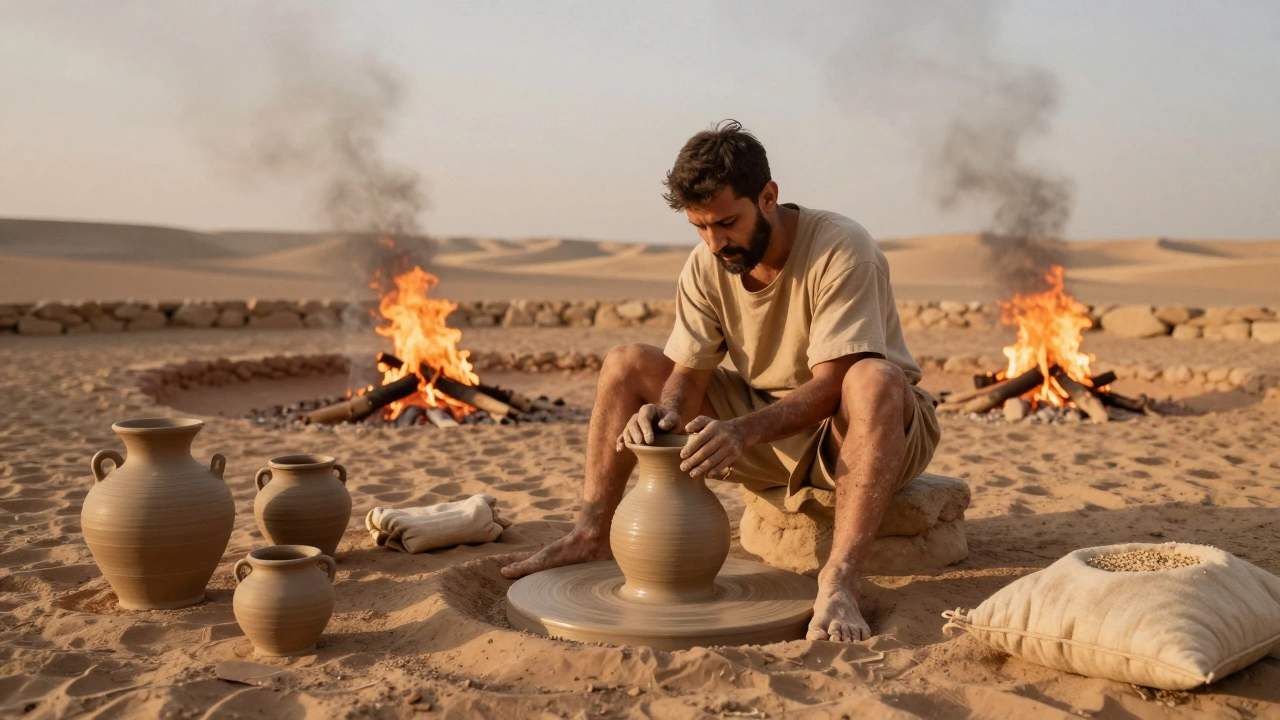
Archaeologists have found pottery shards in India that date back more than 7,000 years. These weren’t fancy vases or ceremonial objects. They were simple, hand-built vessels used to store grain, carry water, and cook food. The earliest examples come from the Mehrgarh site in modern-day Pakistan, which was part of the greater Indus Valley region during the Neolithic period. Around 7000 BCE, people there were shaping clay into bowls and jars, firing them in open pits, and decorating them with basic red slip and black painted designs.This wasn’t just a skill-it was survival. Without pottery, early farming communities couldn’t store surplus harvests. Without storage, there was no food security. No food security, no villages. No villages, no civilization. Pottery was the silent foundation of settled life in ancient India.
The Indus Valley Civilization: Pottery as a Signature
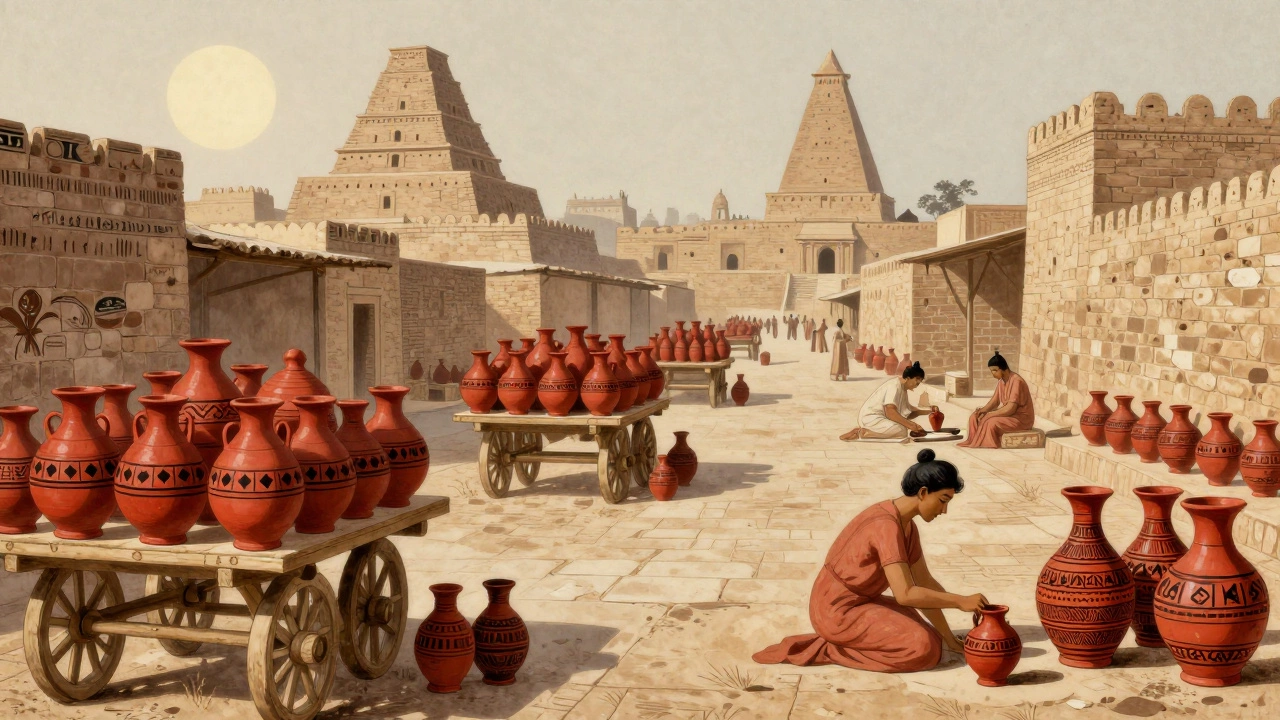
By 2600 BCE, the Indus Valley Civilization-spanning parts of today’s India and Pakistan-had turned pottery into a high-art industry. Cities like Mohenjo-daro and Harappa produced thousands of ceramic items daily. Their pottery wasn’t just functional; it was standardized. The same shapes, sizes, and firing techniques appeared across hundreds of kilometers. That kind of consistency suggests organized workshops, trained artisans, and even early forms of quality control.Harappan pottery is instantly recognizable. Most pieces are made from fine red clay, fired to a hard finish. The most common designs are geometric patterns-dots, circles, wavy lines-painted in black pigment. Some vessels have inscriptions in the still-undeciphered Indus script. These weren’t just pots. They were labels, identifiers, maybe even early trademarks.
Unlike later Indian pottery traditions that leaned into decoration, Harappan pottery valued utility and uniformity. Even their storage jars had narrow necks to reduce evaporation and contamination. They knew how to make things that lasted.
Why Pottery Beats Other Crafts
Some might argue that weaving, metalwork, or bead-making came first. But evidence says otherwise. The earliest woven textiles in India date to around 3000 BCE-nearly 4,000 years after the first pottery. Metal tools and ornaments appeared even later, around 2000 BCE, during the early Vedic period. Beads made from stone and shell go back to 7000 BCE too, but they were ornaments, not tools. Pottery was both.And here’s the key: pottery leaves behind fragments. Wood decays. Cloth rots. Metal gets melted down and reused. But pottery? Even broken, it survives. That’s why archaeologists have more pottery shards from ancient India than any other artifact. It’s the most abundant, most durable, and oldest craft material we have.
Regional Continuity: From Harappa to Today
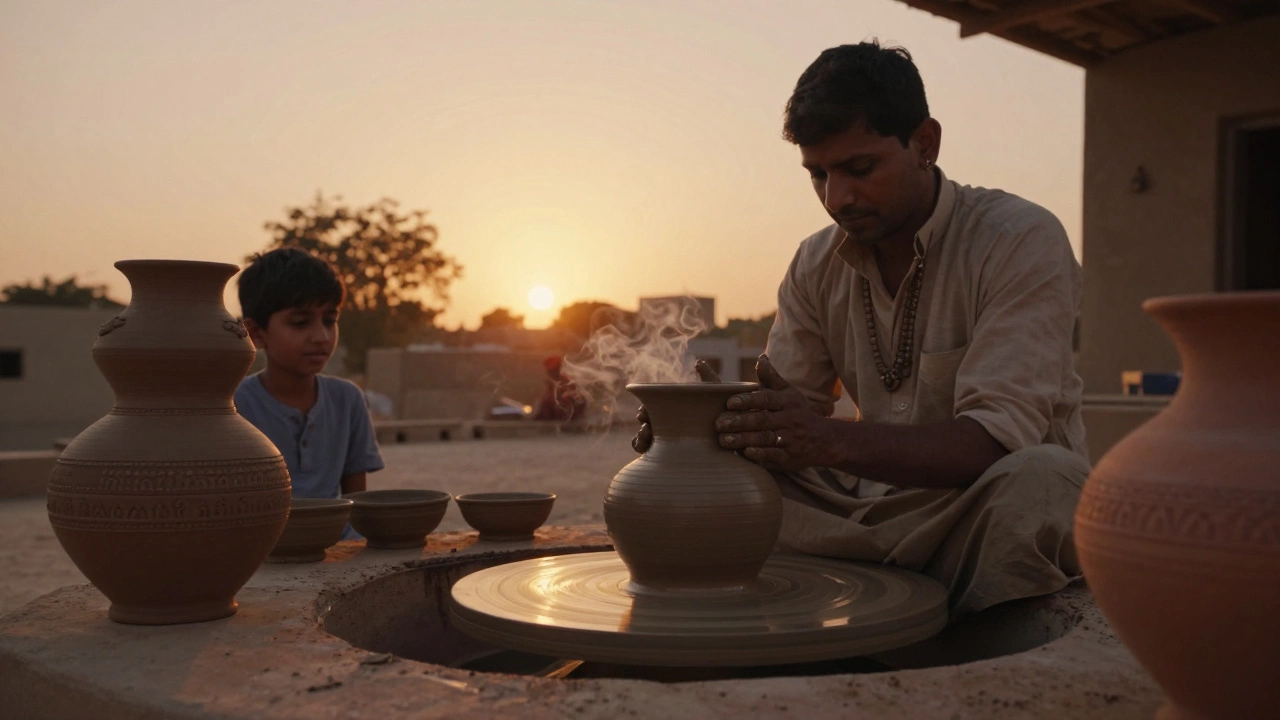
What’s remarkable is that the basic techniques haven’t changed much. In villages across Rajasthan, Gujarat, and Tamil Nadu, potters still use the same coiling method their ancestors did 6,000 years ago. They knead clay by foot, shape it with their hands, dry it in the sun, and fire it in open kilns. No wheels, no electric kilns, no molds. Just skill, patience, and local soil.In some places, like the village of Khurja in Uttar Pradesh, you can still see black pottery made using the same technique as the Indus Valley-burnished with a smooth stone after firing, giving it a mirror-like shine. In Tamil Nadu, the Kondapalli potters make figurines that look uncannily similar to those found in Harappan sites. The shapes may have evolved, but the spirit hasn’t.
Clay as Cultural Memory
Pottery in India isn’t just old-it’s alive. It’s part of rituals. In rural Bengal, clay idols of Durga are molded by hand and dissolved in rivers after Durga Puja, symbolizing return to earth. In Maharashtra, terracotta horses are offered to the goddess Renuka as votive offerings. In Odisha, potters make lamps for Diwali using the same molds passed down for generations.These aren’t tourist crafts. They’re living traditions. Every time a potter presses their thumb into wet clay, they’re connecting to someone who lived in a village on the banks of the Indus River 5,000 years ago.
What Makes It the Oldest Craft-and Still Relevant?
Crafts like embroidery, wood carving, or lacquer work are beautiful. But they depend on materials that are harder to source, tools that require more technology, and skills that take years to master. Pottery? All you need is earth, water, fire, and hands. No special tools. No imported materials. No complex machinery.That’s why it survived invasions, colonial rule, industrialization, and globalization. While other crafts faded or became luxury items, pottery remained essential. Even today, in villages without electricity, people cook on clay stoves and drink from clay cups because they’re cheaper, cooler, and safer than plastic or metal.
And science backs this up. Studies show that water stored in clay pots stays naturally cool and filtered. The porous surface allows slow evaporation, lowering the temperature. Minerals like calcium and magnesium leach into the water, improving taste and even aiding digestion. In a time of plastic pollution and chemical additives, ancient pottery is making a quiet comeback.
Why This Matters Today
When we talk about India’s heritage, we often focus on grand monuments or classical dance. But the real heartbeat of ancient Indian culture lies in the hands of the potter. Not in museums. Not in textbooks. In the dust of village kilns, in the rhythm of the wheel, in the quiet hum of firing clay under the open sky.Pottery is the oldest craft in India because it never stopped being useful. It didn’t need to be preserved. It just kept being made.
| Craft | Earliest Evidence | Material Used | Primary Use |
|---|---|---|---|
| Pottery | 7000 BCE | Clay | Storage, cooking, transport |
| Stone Bead Making | 7000 BCE | Shell, stone, carnelian | Jewelry, trade |
| Textile Weaving | 3000 BCE | Cotton, wool | Clothing, trade |
| Metal Casting | 2000 BCE | Copper, bronze | Tools, ritual objects |
| Wood Carving | 1500 BCE | Teak, sandalwood | Architecture, furniture |
Common Myths About India’s Oldest Craft
Some people assume that because India is famous for silk, embroidery, or marble carving, those must be the oldest. But those crafts emerged much later, often under royal patronage or foreign influence. Pottery predates all of them by thousands of years.
Another myth is that pottery was only a rural craft. In fact, during the Indus Valley period, pottery production was urbanized. Archaeologists have found specialized pottery quarters in Harappan cities, with evidence of mass production and distribution networks. This wasn’t a cottage industry-it was an early manufacturing system.
Where to See Ancient Indian Pottery Today
If you want to see original pieces, head to the National Museum in New Delhi or the Mohenjo-daro Museum in Sindh, Pakistan. You’ll find Harappan jars with painted geometric patterns, miniature figurines, and even cooking pots with soot marks from ancient fires.
But to truly understand it, visit a village kiln. In Pipli (Odisha), in Channapatna (Karnataka), or in the clay fields of Bhuj (Gujarat), watch a potter shape a vessel with no tools but their fingers. You’re not just watching a craft-you’re watching time.
Is pottery really the oldest craft in India?
Yes. Archaeological evidence from Mehrgarh (7000 BCE) shows pottery was being made in the Indian subcontinent over 9,000 years ago. Other crafts like weaving and metalwork appeared thousands of years later. Pottery’s durability and widespread use make it the oldest confirmed craft.
Did ancient Indians use the potter’s wheel?
They did-but much later. The earliest pottery in India (7000 BCE) was hand-built using coiling and pinching. The potter’s wheel arrived around 3000 BCE, during the mature Harappan phase. It allowed for faster, more uniform production, but many rural potters still avoid it today.
What makes Harappan pottery different from later Indian pottery?
Harappan pottery was standardized, functional, and minimally decorated. Later traditions like the Painted Grey Ware or Northern Black Polished Ware focused more on aesthetics, glazing, and symbolic patterns. Harappan pots were made for daily use in large urban centers; later pottery often served ritual or elite purposes.
Why is ancient pottery still used in rural India?
Clay pots naturally cool water, are non-toxic, and are affordable. In villages without refrigeration or clean water systems, they’re more practical than plastic or metal. They’re also culturally embedded-used in rituals, cooking, and storage across generations.
Can I buy authentic ancient Indian pottery today?
You can’t buy actual ancient pottery-it’s protected heritage. But you can buy modern replicas made by traditional potters using the same methods. Look for artisans in Khurja, Bhuj, or Kondapalli who follow Indus Valley techniques. These pieces are not souvenirs-they’re living history.
What Comes Next?
There’s a quiet revolution happening. Young designers in Delhi and Bengaluru are partnering with village potters to create modern tableware using ancient techniques. Eco-conscious brands are promoting clay bottles instead of plastic. UNESCO has recognized Indian terracotta traditions as intangible cultural heritage.
But the real future of this craft isn’t in galleries or online stores. It’s in the hands of a child in a village, learning to shape clay from their grandmother. That’s how the oldest craft in India stays alive-not by being preserved, but by being used.