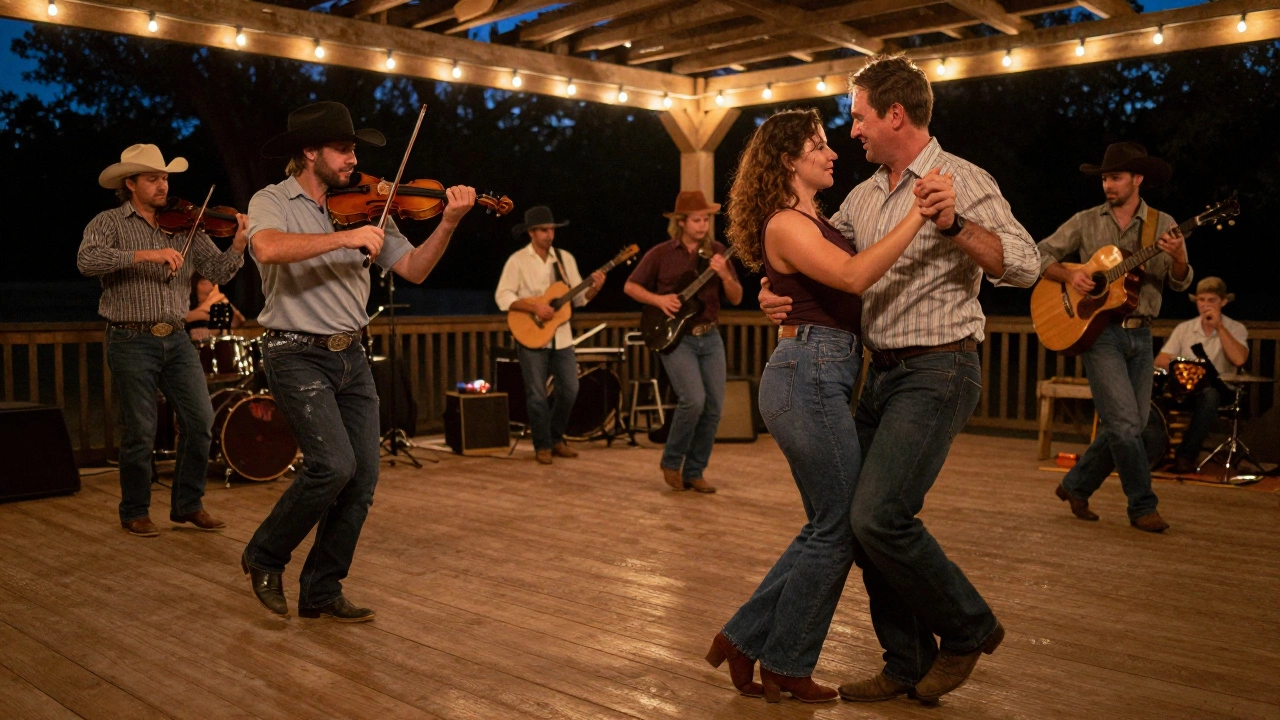
There’s no such thing as Texas dance as a single, official style - but that’s exactly what makes it powerful. If you’ve ever been to a country bar in Austin or a rodeo in Lubbock and seen people stepping, spinning, and shuffling in sync to fiddles and steel guitars, you’ve seen Texas dance in action. It’s not one dance. It’s a whole family of movements shaped by cowboy culture, German and Czech immigrants, Mexican rancheros, and African American rhythms. Texas dance isn’t taught in studios. It’s learned on the floor, in sweat and laughter, with boots on and hats off.
What You’re Really Seeing: Texas Swing
The most common form people call Texas dance is Texas swing. It’s a partner dance born in the 1930s and 40s in dance halls like the Esquire Ballroom in Fort Worth and the Broken Spoke in Austin. It’s based on swing dancing - think Lindy Hop - but with a slower, looser feel. Dancers glide instead of bounce. They use more open positions. There’s room to improvise, to turn on a dime, to let the music breathe.
Unlike ballroom swing, Texas swing doesn’t follow rigid patterns. There’s no fixed count. The lead guides with subtle weight shifts, not arm pulls. The follow responds, not reacts. It’s conversation, not choreography. You’ll hear it in songs by Bob Wills & His Texas Playboys, Asleep at the Wheel, or even modern bands like The Randy Rogers Band. The rhythm is in the shuffle step: step-step, kick-step, step-step, slide.
The Official State Dance? It’s Not What You Think
In 1991, the Texas Legislature declared square dancing the official state dance. That surprised a lot of people. Square dancing? Isn’t that for barn raisings and elementary school P.E.? Yes - but that’s the point. Square dancing in Texas isn’t the stiff, four-couple formation you might remember from childhood. Texas square dancing is wilder, faster, and more musical. Callers don’t just say "do-si-do" - they throw in jokes, pop culture references, and even song lyrics. Dancers switch partners mid-set. It’s social, unpredictable, and deeply Texan.
Why square dancing? Because it’s the only dance form that crosses every border in the state. Rural communities, urban suburbs, military bases, and college towns all have active square dance clubs. There are over 300 square dance clubs in Texas today. You’ll find them in places like Amarillo, El Paso, and even Houston’s suburbs. It’s not a relic. It’s alive.
Line Dancing: The Quiet Giant
Walk into any country bar in Texas after 8 p.m., and you’ll see it: a long line of people, all facing the same direction, stepping in unison to a country tune. That’s line dancing. It’s not exclusive to Texas - but Texas made it explode.
Line dancing became a phenomenon in the 1980s and 90s, thanks to hits like "Achy Breaky Heart" and "Boot Scootin’ Boogie." But Texas dancers didn’t just copy the moves. They created them. The "Tush Push," the "Copperhead Road," the "Texas Two-Step" - most of the big line dance routines were choreographed by Texans, often in small-town dance halls. These aren’t just steps. They’re stories. The "Boot Scootin’ Boogie" has 24 counts, each one matching a beat in the song. You don’t memorize them - you feel them.
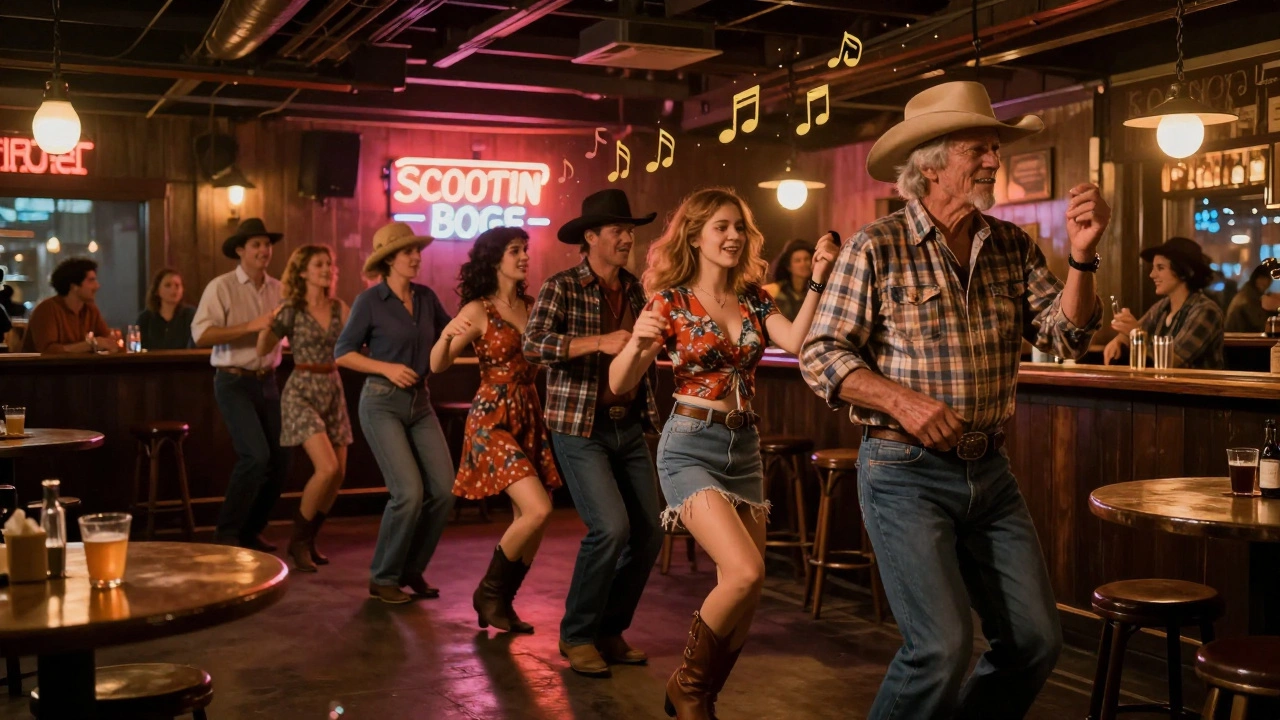
What makes Texas line dancing different? The attitude. People don’t care if you’re perfect. They care if you’re there. A 70-year-old rancher and a 20-year-old college student will dance side by side, smiling, not judging. That’s the Texas way.
Where to Experience It - Not as a Tourist, But as a Participant
If you want to see Texas dance, don’t go to a museum. Go to a dance hall.
- The Broken Spoke in Austin - still open since 1964. No neon signs. No cover charge on weekdays. Just a wooden floor, a jukebox, and generations of dancers.
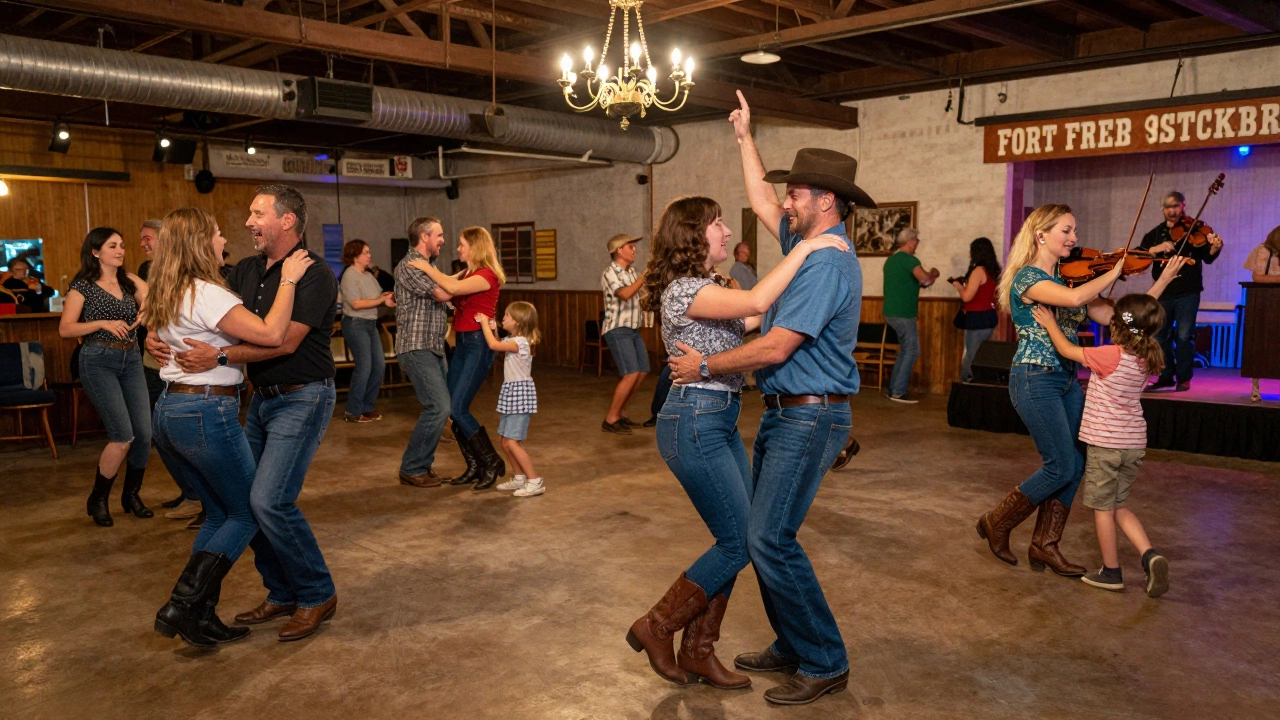
- Fort Worth Stockyards - every Saturday night, they host a dance with live bands and beginner lessons at 7 p.m. No experience needed.
- Willie’s Saloon in Houston - where the line dancing starts at 8 and doesn’t stop until 2 a.m.
- San Antonio’s Dance Hall - a 100-year-old building with a ceiling painted like the night sky. They play polka one night, swing the next.
You don’t need to know how to dance to walk in. Just show up. Ask someone to show you the basic step. Most will grin, take your hand, and say, "Just follow the beat. Don’t think about it."
Why Texas Dance Doesn’t Fit in a Box
There’s no one answer to "What is the Texas dance?" because Texas doesn’t have one culture - it has many layered over each other.
German immigrants brought polka. Mexican vaqueros brought the two-step. African American musicians brought swing rhythms. Country singers brought the shuffle. And all of it got mashed together under the hot Texas sun.
That’s why you can walk into a dance hall in Lubbock and hear a polka tune followed by a country ballad followed by a hip-hop remix played on a fiddle. The dancers don’t skip a beat. They just adjust their steps. That’s the real Texas dance: adaptability. Community. Joy.
How to Start - Even If You’ve Never Danced Before
You don’t need fancy shoes. You don’t need lessons. You just need to show up.
- Find a local dance hall or country bar with weekend dancing. Check Facebook events or local tourism sites.
- Go early. First hour is usually beginner-friendly.
- Watch for 10 minutes. Notice how people move their feet. Don’t copy - feel.
- Ask someone: "Can you show me the basic two-step?" Most will say yes.
- Step with your left foot, then right, then slide. That’s it. The rest comes with time.
Don’t worry about getting it right. The best dancers in Texas didn’t start perfect. They started scared. They kept showing up. That’s the only rule.
What You Won’t Find in Texas Dance
You won’t find rigid rules. You won’t find competitions with judges. You won’t find people in costumes. Texas dance isn’t about performance. It’s about connection.
There’s no certification. No rankings. No YouTube tutorial that can teach you what a dance hall can. You learn by being there - by sweating, by laughing, by stepping on someone’s toe and saying "sorry," and them saying "no problem, again?"
That’s the heart of it. Texas dance isn’t about the steps. It’s about the space between them - the silence between beats where people smile at each other without saying a word.
Is Texas dance the same as line dancing?
No. Line dancing is one part of Texas dance - but not the whole thing. Texas dance includes swing, two-step, square dancing, and even some folk styles. Line dancing is done in lines, facing the same direction. Swing and two-step are partner dances. All of them are practiced in Texas, but they’re different.
Do you need to wear cowboy boots to dance in Texas?
No. But boots help. Leather soles let you glide smoothly on wooden floors. Sneakers can stick. Heels can sink. If you’re just trying it out, any flat, smooth-soled shoe will do. Save the boots for when you’re hooked.
Is Texas dance only for country music fans?
Not at all. You’ll hear blues, rockabilly, zydeco, and even modern pop remixed with fiddles. The music changes, but the rhythm stays. If you like to move your feet to a beat, you’ll find your place. Many dancers say they came for the music - and stayed for the people.
Are there age limits for Texas dance?
No. You’ll see 8-year-olds learning two-step next to 80-year-olds doing the same moves. Dance halls in Texas are some of the few places where generations mix without judgment. It’s common to see grandparents teaching grandchildren. That’s the tradition.
Can I learn Texas dance online?
You can learn steps online - but not the culture. Videos can show you the footwork, but they can’t teach you how to lead with a glance, or how to laugh when you miss a step. The real lesson happens on the floor, with real people. Online is a start. The dance hall is the destination.
What Comes Next?
If you’ve never danced before, your first night might feel awkward. That’s normal. The second night, you’ll recognize a few faces. The third, someone will ask you to dance. By the fourth, you’ll be the one offering your hand to a stranger.
Texas dance isn’t about perfection. It’s about presence. It’s about showing up, even when you’re tired. Even when you’re nervous. Even when you think you can’t do it.
That’s the secret. You don’t need to know how to dance to be part of Texas dance. You just need to be willing to step forward - and let the music carry you.