
Indian Culture Adoption Index Calculator
Cultural Adoption Index
Calculate how deeply countries integrate Indian culture by comparing key metrics from the article.
When you think of Indian culture spreading across the world, you might picture Bollywood movies in Nigeria, yoga studios in Berlin, or curry houses in London. But one country stands out-not just for enjoying Indian food or wearing henna, but for truly living, breathing, and reshaping Indian culture in its own soil. That country is the United States.
Yoga Isn’t Just a Workout-It’s a Way of Life in America
More than 37 million Americans practice yoga regularly, according to a 2024 survey by the Yoga Alliance. That’s more than the entire population of Canada. And it’s not just about stretching. In the U.S., yoga is tied to mindfulness, mental health, and even corporate wellness programs. Companies like Google and Apple offer on-site yoga classes. Schools in California and New York teach yoga to kids as part of their social-emotional learning curriculum. The U.S. doesn’t just adopt yoga-it redefines it. Studios in Portland offer ‘yoga and kombucha’ sessions. In Austin, you’ll find ‘sound bath yoga’ with Tibetan bowls. This isn’t just cultural appreciation. It’s cultural integration.
The Indian Diaspora Is the Largest and Most Influential in the World
Over 5 million people of Indian origin live in the United States. That’s the largest Indian diaspora outside of India itself. They’re not just immigrants-they’re doctors, engineers, CEOs, politicians, and artists shaping American society. Satya Nadella runs Microsoft. Vivek Ramaswamy ran for president. Kamala Harris, the first Indian-American vice president, has Indian heritage on her mother’s side. Indian immigrants make up nearly 25% of all U.S. tech workers. In Silicon Valley, Indian founders started over 15% of all tech startups between 2006 and 2020, according to a Stanford study. These aren’t just numbers-they’re people who bring Diwali celebrations to city halls, teach Sanskrit in universities, and open Ayurvedic clinics in suburban malls.
Indian Food Is No Longer ‘Exotic’-It’s Mainstream
When you walk into a grocery store in Minneapolis or Miami, you’ll find turmeric, ghee, and masala blends next to olive oil and soy sauce. Indian restaurants aren’t just in big cities-they’re in small towns. In 2023, the number of Indian restaurants in the U.S. surpassed 15,000, according to the National Restaurant Association. That’s more than the number of Starbucks locations. And the food isn’t just butter chicken and naan anymore. You’ll find Kashmiri Rogan Josh in Seattle, Goan fish curry in Chicago, and Andhra spicy curries in Atlanta. American chefs are now competing in Indian cooking competitions on Food Network. A 2024 survey found that 68% of Americans under 35 have tried at least five different regional Indian dishes. That’s deeper than most Indians living in India themselves.

Indian Festivals Are Now Public Events
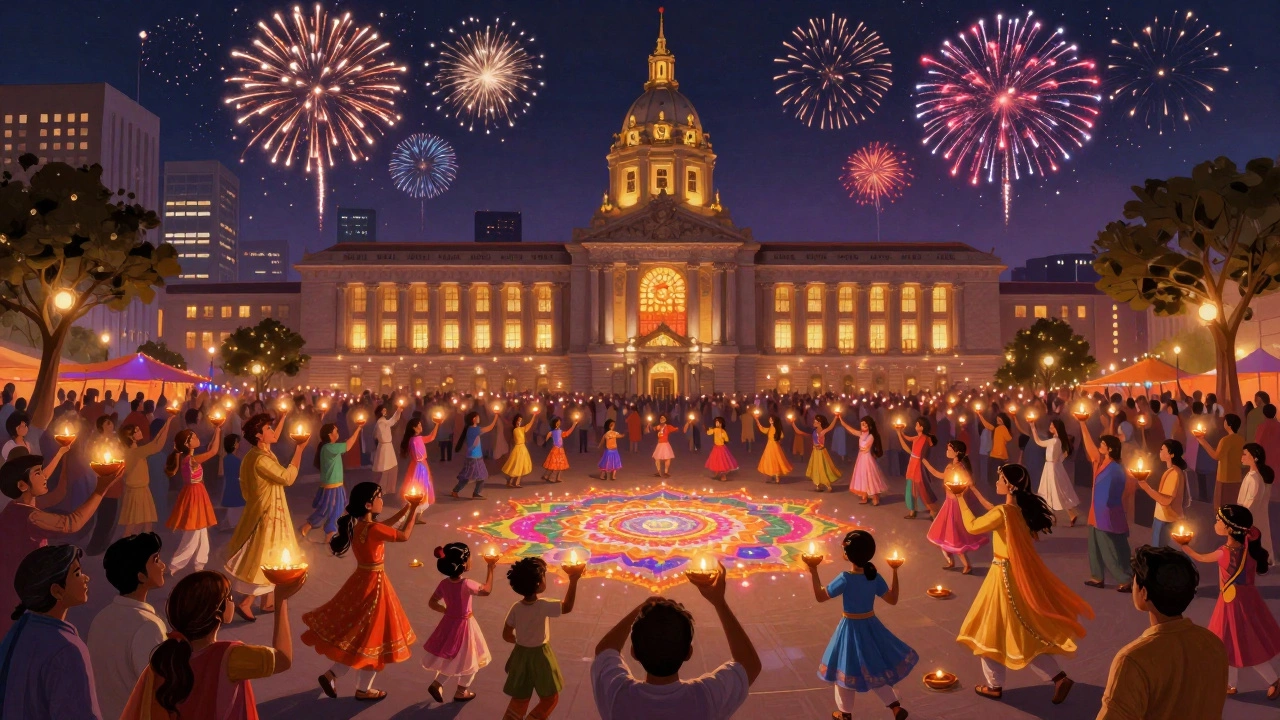
Diwali isn’t just celebrated in homes anymore. In New York City, the mayor lights the Diwali lamp at City Hall. In San Francisco, the Hindu Temple hosts a public Diwali fair with 50,000 attendees. Houston’s Holi festival draws over 100,000 people every year-more than the population of many Indian cities. These aren’t private gatherings for expats. They’re city-sponsored events with police escorts, school field trips, and local news coverage. In 2023, the state of New Jersey officially recognized Diwali as a public school holiday. That’s the first time any U.S. state did so. It’s not just tolerance-it’s institutional adoption.
Indian Spirituality Has Rewired American Mental Health
Transcendental Meditation, taught by Maharishi Mahesh Yogi, became popular in the 1960s with The Beatles. Today, it’s in hospitals. The Cleveland Clinic offers TM programs for chronic pain and PTSD. The VA gives veterans access to meditation apps based on Indian techniques. A 2025 study by Harvard Medical School found that 41% of Americans who use meditation for anxiety learned the practice from Indian sources like Vipassana or Kundalini. Buddhist retreat centers in California, many modeled after Indian monastic traditions, now host over 200,000 visitors annually. This isn’t trend-following. It’s a quiet revolution in how Americans think about peace, stress, and healing.
Indian Classical Arts Are Taught in Top Universities
At UCLA, students can major in Indian classical dance. At Yale, there’s a full course on Hindustani ragas. The Juilliard School has a visiting professor from India who teaches tabla to percussion majors. These aren’t electives for curious students-they’re accredited programs with degrees and scholarships. In 2024, over 3,000 American students enrolled in formal Indian classical music training. That’s more than the number of students in India’s top three music academies combined. The U.S. is now the largest exporter of Indian classical musicians outside India.
Why Not Other Countries?
You might think of the UK, with its large South Asian population, or Canada, with its multicultural policies. But the UK’s connection is often tied to colonial history-it’s a legacy, not a choice. Canada has strong Indian communities, but its cultural adoption is more passive. The U.S. is different. It doesn’t just accept Indian culture-it remixes it. Indian fashion inspires American runway collections. Bollywood dance moves show up in pop music videos. Sanskrit phrases appear in TikTok trends. The U.S. doesn’t see Indian culture as foreign. It sees it as a resource-a tool for creativity, healing, and identity.
What This Means for India
India’s soft power isn’t just about exporting temples or spices. It’s about how deeply its ideas take root elsewhere. When American kids learn to meditate, when yoga instructors in Ohio teach pranayama, when a high school in Texas performs a Kathak recital-it’s not just admiration. It’s transformation. India’s culture is no longer confined to its borders. It’s alive in the daily rhythms of a country that never colonized it, never ruled it, but chose to embrace it.
Is the United States the only country that loves Indian culture?
No, but it’s the most widespread. Countries like the UK, Canada, Australia, and the UAE have large Indian communities and celebrate Indian festivals. But none combine scale, institutional support, and cultural remixing like the U.S. For example, while the UK has curry houses and Diwali parades, the U.S. has Indian philosophy in university curriculums, yoga in corporate wellness programs, and Hindu deities in mainstream art galleries.
Do Indians in the U.S. still practice their traditions?
Yes, and they’re teaching them to non-Indians too. Indian-American families celebrate Diwali, Holi, and Navratri with the same rituals as in India. But they’re also opening community centers where anyone can learn Sanskrit, join a bhajan group, or attend a Vedic astrology workshop. The second and third generations are often more fluent in Indian traditions than their parents were, because they’re actively choosing to preserve them-not just out of obligation, but because they see their value in American life.
Has Indian culture changed because of its popularity in the U.S.?
Yes, but not in a negative way. Some practices have been simplified-like yoga losing its spiritual roots in some studios-but others have been elevated. Indian classical music now has global audiences. Ayurveda is being studied in clinical trials at Johns Hopkins. The U.S. has helped Indian culture become more visible, more respected, and more adaptable. It’s not dilution-it’s evolution.
What’s the biggest misconception about Indian culture abroad?
That it’s all about spirituality and mysticism. People think Indian culture is just yoga, meditation, and incense. But it’s also complex systems of governance from ancient texts like the Arthashastra, advanced astronomy from Aryabhata, and intricate textile techniques like Kanchipuram silk weaving. The U.S. is starting to learn these too-universities now offer courses on ancient Indian mathematics and metallurgy. The real depth is still being uncovered.
Will other countries catch up to the U.S. in embracing Indian culture?
Possibly, but it would take decades. The U.S. has a unique mix: freedom of religion, a culture that celebrates reinvention, massive funding for arts and wellness, and a population open to global ideas. Countries like Germany or Japan have deep respect for Indian philosophy, but they don’t have the same scale of adoption. The U.S. didn’t just welcome Indian culture-it made it part of its own story.