Line Dancing: What It Is and How It Connects to Indian Dance Traditions
When you think of line dancing, a choreographed group dance performed in lines, often to country or pop music, with repeated steps and no partner switching. It’s often seen as a Western social activity—think boots, country tunes, and wedding receptions. But the idea of people moving in unison, following a set pattern, isn’t new. In fact, it’s deeply rooted in cultures worldwide, including India, where dance has always been about rhythm, repetition, and collective expression.
Bharatanatyam, a classical Indian dance form from Tamil Nadu with strict postures, precise footwork, and codified gestures passed down for over 2,000 years might seem far from a line dance. But both rely on the same core idea: movement as a shared language. In Bharatanatyam, dancers don’t just perform—they follow a strict sequence of adavus, or steps, repeated in rhythm. Groups of students train together, mirroring each other’s motions, forming living lines of precision. This isn’t random—it’s structured, communal, and deeply ritualized. Similarly, folk dances, regional group dances like Bhangra, Garba, or Kolattam, performed in circles or lines during festivals and celebrations in India follow repeating patterns. In Kolattam, dancers stand in lines or circles, striking sticks in time with song. In Garba, people move in concentric circles, stepping in sync to the beat. These aren’t just parties—they’re coded movements, passed down like oral history, where every step carries meaning.
What makes line dancing and these Indian forms so alike isn’t the music or the costumes—it’s the structure. Both require memory, timing, and group cohesion. You don’t need to be a trained dancer to join a line dance. You just need to follow the count. The same is true in many Indian village festivals—anyone can step in, learn the pattern, and become part of the flow. The difference? Indian forms often tie those steps to spiritual stories or seasonal cycles. A line dance might celebrate a wedding. A Kolattam dance might honor the harvest. Both bring people together through motion.
So when you see people lined up, stepping to the beat, whether in a Texas bar or a Tamil temple courtyard, you’re seeing the same human impulse: to move together, in rhythm, as one. That’s not just dance. It’s connection. Below, you’ll find articles that explore how structured movement—whether strict classical forms or lively folk traditions—shapes identity, community, and culture across India.
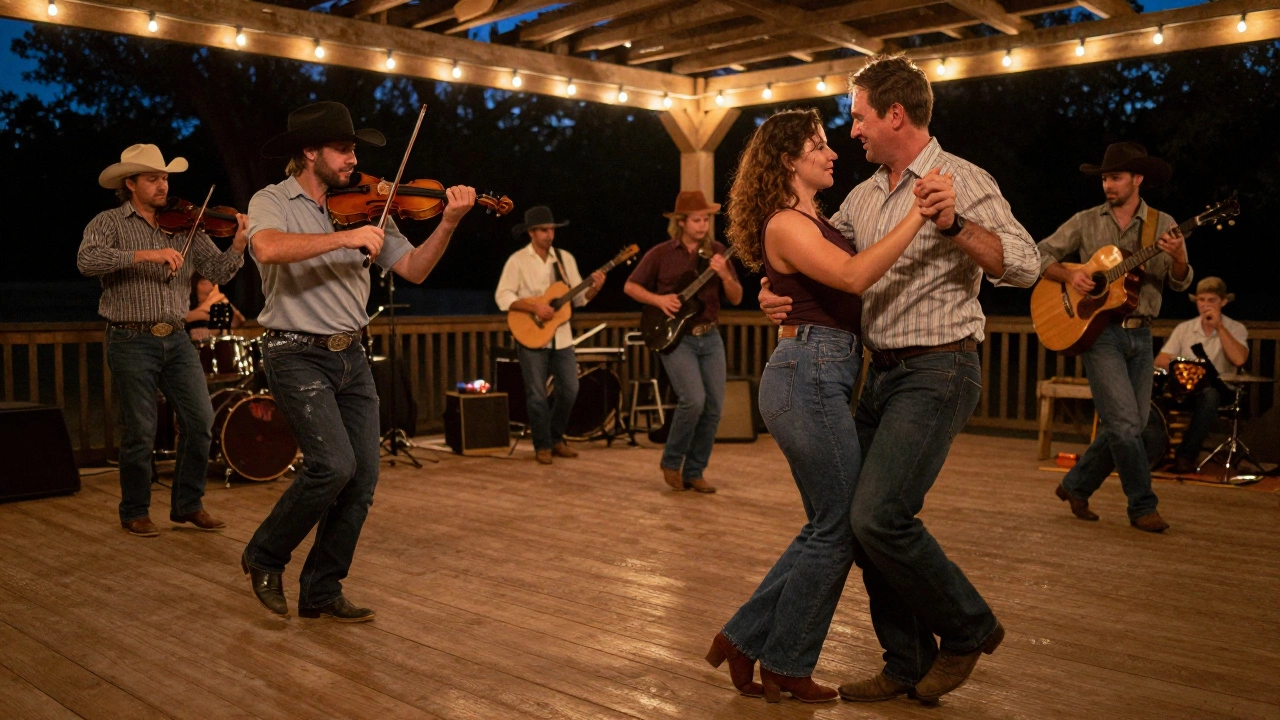
What Is the Texas Dance? A Guide to Texas Swing and State Dance Traditions
Texas dance isn't one style - it's a living mix of swing, two-step, line dancing, and square dancing shaped by cowboy culture and immigrant traditions. Learn where to experience it and how to start dancing, no experience needed.
Read more