Find Your Perfect Indian Folk Dance
Not sure which dance style suits you? Answer three quick questions about your preferences and we'll recommend the perfect Indian folk dance for you.
Picture this: you are at a wedding or a festival. The music starts, everyone is moving, and you feel that familiar tug in your chest-the desire to join in. But then doubt creeps in. "I don't know the steps," you think. "My coordination is terrible." "I'll look silly."
If you have ever felt this way, you are not alone. Many people believe that Indian dance forms are incredibly difficult, requiring years of rigorous training and perfect flexibility. While classical styles like Bharatanatyam or Kathak certainly demand dedication, there is a whole world of regional folk dances designed specifically for community participation. These styles prioritize joy, rhythm, and expression over technical perfection.
The short answer to "what is the easiest dance form to learn?" is usually a regional folk style from North India, such as Bhangra or Giddha. However, the "best" easy dance depends on your body type, musical taste, and where you live. This guide breaks down the most accessible options so you can start moving with confidence today.
Why Folk Dance is the Gateway for Beginners
To understand why certain dances are easier, we need to look at their origins. Classical Indian dance evolved in temples and royal courts. It was codified by gurus into strict systems of movement (mudras) and footwork (tala). Learning these is like learning a new language; every hand gesture has a specific meaning, and every step must hit a precise beat.
Folk dance, on the other hand, grew out of villages and fields. It was created by farmers celebrating harvests, lovers expressing affection, and communities marking festivals. The goal was never perfection; it was participation. If you missed a step in a harvest dance, nobody cared-as long as you were having fun.
This fundamental difference makes folk dance much more forgiving for beginners. Here is what makes them accessible:
- Simplicity of Steps: Most movements mimic daily life-planting rice, churning butter, or walking across a field. You likely already know how to do these motions naturally.
- Group Dynamics: Folk dances are often performed in circles or lines. You follow the person next to you, reducing the pressure to memorize choreography solo.
- Rhythm Over Precision: Keeping time with the dhol (drum) is more important than hitting an exact geometric position.
The Top Contender: Bhangra from Punjab
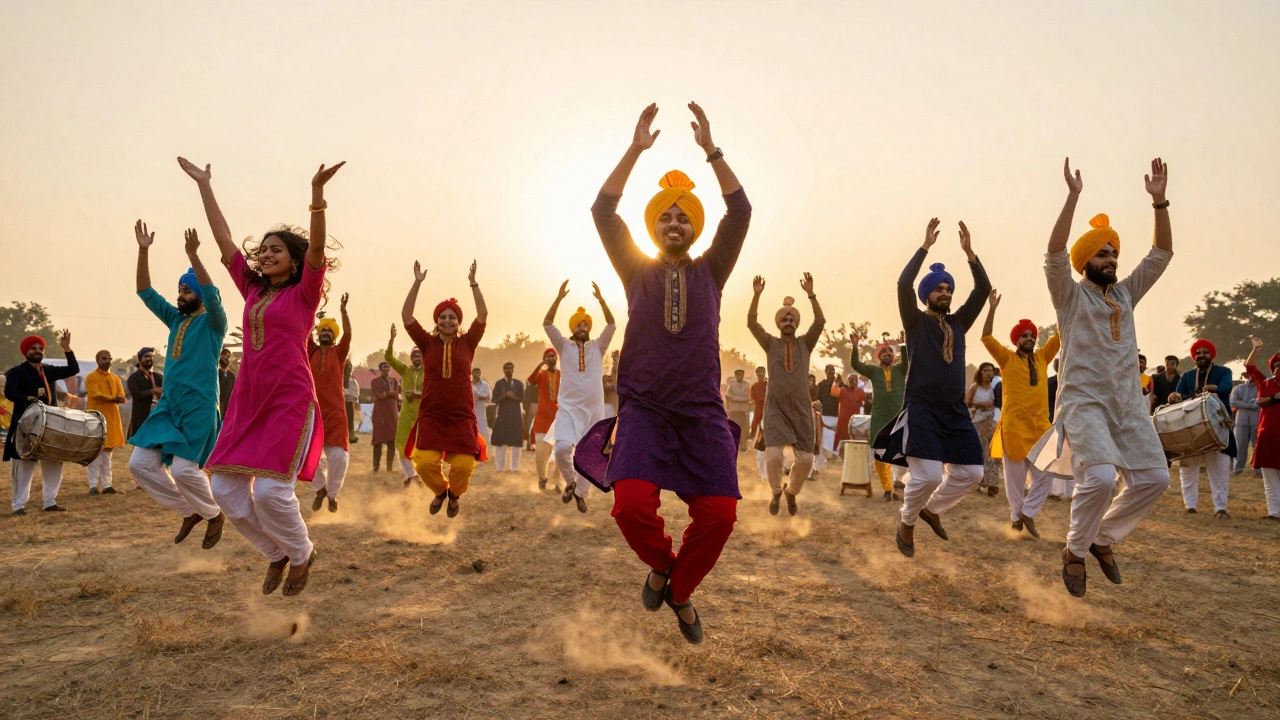
If you ask any dance instructor in London or Delhi which dance is easiest for a complete novice, they will almost certainly say Bhangra is a high-energy folk dance from the Punjab region of India and Pakistan.
Bhangra originated as a celebration of the spring harvest (Vaisakhi). Men would jump, clap, and shout in excitement. Today, it is a global phenomenon. Why is it so easy?
- Natural Movements: The core moves involve jumping, clapping above your head, and stomping your feet. These are instinctive human reactions to excitement. You don't need flexible joints or a trained spine.
- High Energy Masks Mistakes: Because the dance is fast and vigorous, small errors in posture are invisible. As long as you are energetic, you look like you belong.
- Abundant Resources: Because Bhangra is popular worldwide, you can find thousands of free tutorials on YouTube. You don't need a formal teacher to pick up the basics in a weekend.
For women, the female counterpart is Giddha is a traditional folk dance performed by women in Punjab, involving rhythmic clapping and playful dialogue. Giddha involves two rows of women facing each other, clapping hands and singing call-and-response songs. The footwork is minimal; the focus is on the upper body, hip sways, and vocal interaction. It is incredibly social and requires zero prior experience.
The Graceful Option: Garba from Gujarat
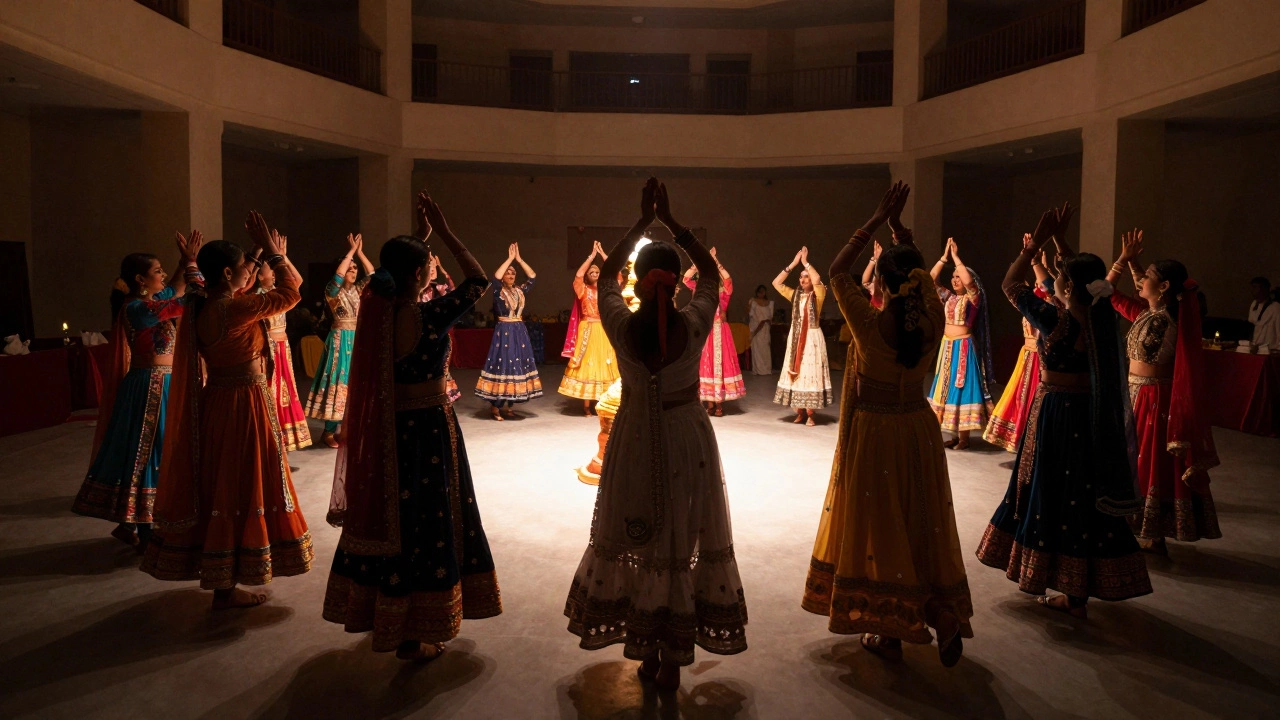
If Bhangra feels too aggressive or exhausting, consider Garba is a circular folk dance from Gujarat, traditionally performed during the Navratri festival. Garba is arguably the most inclusive dance form in India because it is entirely group-based.
In Garba, dancers stand in concentric circles around a lamp or a statue of the goddess Durga. Everyone faces the center and moves in unison. The basic step is simple: step forward with one foot, tap the heel of the other, turn slightly, and repeat. Your hands clap above your head or move in graceful arcs.
Here is why Garba is a hidden gem for beginners:
- No Solo Spotlight: You are part of a massive circle. No one is watching you individually. You blend into the collective movement.
- Repetitive Structure: The steps are repetitive loops. Once you learn the basic four-step sequence, you can dance for hours without learning anything new.
- Low Physical Barrier: Unlike Bhangra, Garba does not require jumping. It is low-impact and suitable for all ages and fitness levels.
During the nine nights of Navratri, millions of people who have never danced before join the Garba circles. By night three, most beginners are comfortable enough to add their own flair.
Other Accessible Regional Styles
While Bhangra and Garba are the top two, other regional dances offer unique benefits depending on your preferences.
| Dance Form | Region | Difficulty Level | Key Focus | Best For |
|---|---|---|---|---|
| Bhangra | Punjab (North) | Very Low | Energy & Jumping | High-energy individuals, cardio lovers |
| Garba | Gujarat (West) | Very Low | Circular Movement & Clapping | Shy dancers, low-impact preference |
| Dandiya Raas | Gujarat (West) | Low | Stick Coordination | Those who want a prop to hold |
| Lavani | Maharashtra (West) | Medium-Low | Hip Movement & Footwork | People who enjoy rhythmic stomping |
| Bihu | Assam (Northeast) | Low | Fluid Arm Movements | Those who prefer gentle, flowing motion |
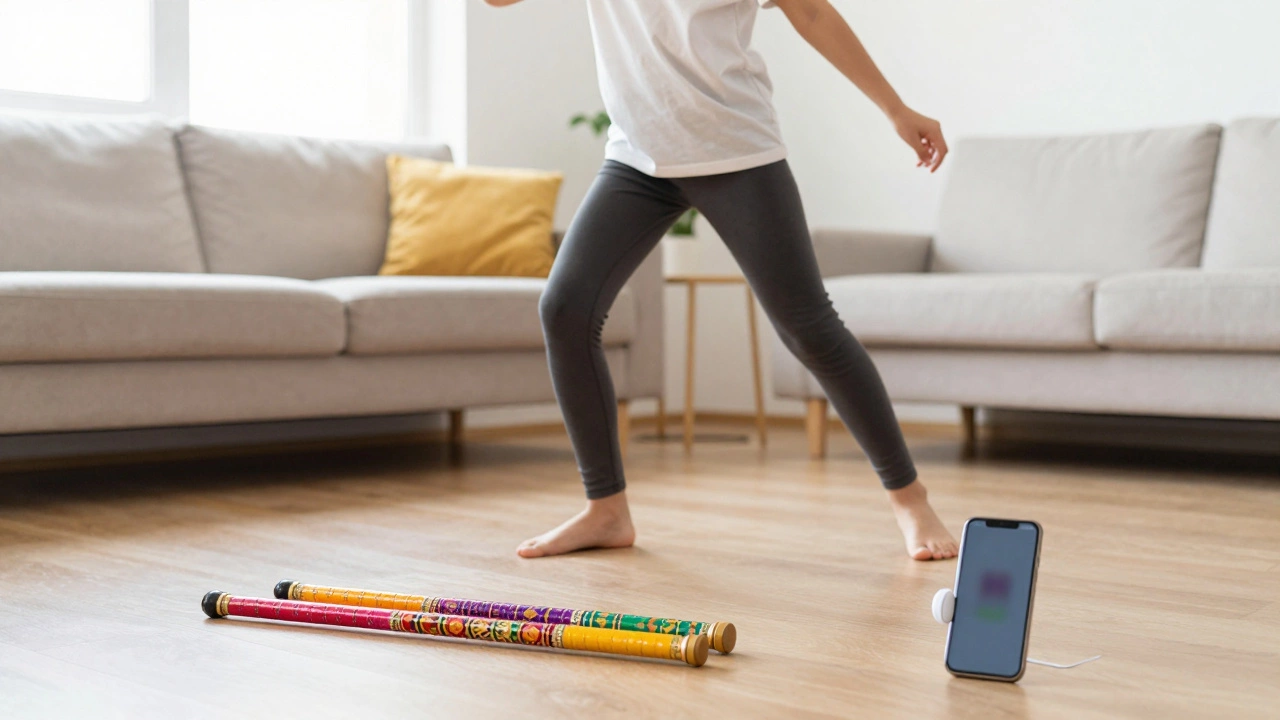
Dandiya Raas is a variation of Garba that uses colorful sticks (dandiyas) which dancers strike together in rhythm. If holding props helps you feel less awkward, Dandiya is perfect. The sticks give your hands something to do, which reduces self-consciousness. The basic pattern is simply striking the stick against your partner's stick in a set rhythm while stepping side-to-side.
Lavani is a folk dance form from Maharashtra characterized by rapid footwork and expressive hip movements. While professional Lavani dancers are highly skilled, the basic folk version involves a strong, stomping footwork pattern called "lavani taali." It is grounded and powerful. You don't need to be flexible; you just need to keep your knees bent and your feet moving to the beat of the dholki drum.
How to Start Learning Today
You do not need to enroll in a six-month course to enjoy these dances. Here is a practical roadmap to get started within your first week.
Step 1: Choose Your Music
Dance is driven by rhythm. Find playlists for "Bhangra hits" or "Navratri Garba beats" on Spotify or YouTube. Listen to them daily. Try to tap your foot or clap along. Internalizing the beat is 50% of the battle.
Step 2: Watch and Mirror
Search for "Bhangra basics for beginners" or "Garba steps tutorial." Look for videos that break down the moves slowly. Pause the video after each step and mimic it. Do not worry about looking good. Worry about matching the movement.
Step 3: Practice in Small Bursts
Set a timer for five minutes. Put on the music and try to move freely. If you forget the steps, just jump or clap. Consistency matters more than duration. Five minutes a day is better than one hour once a month.
Step 4: Join a Community Event
In cities like London, Mumbai, or New York, cultural associations host open dance nights. These are not competitions; they are parties. Go with a friend. Stand on the edge of the circle. Watch for ten minutes, then join in. Nobody will judge you-they are too busy enjoying themselves.
Common Pitfalls to Avoid
Even with easy dances, beginners make mistakes that hinder progress. Avoid these traps:
- Overthinking: Do not analyze every finger position. Folk dance is about flow. If you stop to correct your pinky toe, you lose the rhythm.
- Comparing Yourself: You will see people who have been dancing since childhood. They are not better than you; they are just earlier starters. Focus on your own improvement.
- Ignoring the Feet: In many Indian dances, the feet carry the rhythm. Keep your steps light and crisp. Dragging your feet kills the energy.
- Skipping the Warm-up: Even simple jumps can strain your ankles if you are cold. Spend two minutes stretching your calves and wrists before dancing.
Is Classical Dance Ever Easy?
A common question is whether any classical dance is beginner-friendly. The honest answer is no. Kathak is a classical dance form from North India known for its intricate footwork and storytelling. Kathak is often cited as the "easiest" classical dance because it allows for some improvisation and focuses heavily on footwork (tatkar), which is somewhat intuitive. However, it still requires months of practice to master the basic stance (aramandi) and hand gestures.
If you are determined to explore classical dance, start with Kathak workshops designed for adults. But for pure ease and immediate gratification, stick to folk styles. You can always transition to classical later if you develop a deeper interest.
Final Thoughts on Finding Your Rhythm
The "easiest" dance is the one that makes you smile. If you love high energy and loud drums, Bhangra is your path. If you prefer community harmony and graceful circles, choose Garba. If you like props and structure, try Dandiya.
Remember, dance is not a performance for others; it is an expression for yourself. The beauty of Indian regional dance lies in its accessibility. It was never meant to be locked away in studios. It belongs in the streets, the fields, and the living rooms. So, put on some music, clear some space, and take that first step. You might be surprised by how natural it feels.
Can I learn Bhangra without knowing Hindi?
Absolutely. Bhangra is primarily a physical dance driven by rhythm and energy. While the songs are in Punjabi, you do not need to understand the lyrics to dance. Focus on the beat of the dhol drum. Many non-Indian learners become excellent Bhangra dancers simply by following the visual cues of the group.
Do I need special clothing to learn folk dance?
No. Traditional attire like salwar kameez or lehengas can be restrictive for beginners. Wear comfortable clothes that allow free movement, such as leggings and a t-shirt, or loose trousers and a cotton top. Save the traditional costumes for performances or festivals once you are confident in your steps.
Is Garba only for women?
Not anymore. Traditionally, Garba was often segregated by gender, but modern celebrations are fully co-ed. Men and women dance together in the same circles. The steps are universal, though men may add more vigorous jumps while women may emphasize graceful hand movements. Everyone is welcome.
How long does it take to learn basic Bhangra?
You can learn the basic Bhangra stance and two-step jump in under 30 minutes. To feel comfortable performing a short routine, aim for 2-3 weeks of casual practice (10-15 minutes a day). Mastery takes longer, but enjoyment is immediate.
Are there online classes for beginners?
Yes. Platforms like YouTube offer countless free tutorials. Additionally, websites like Udemy or specialized dance academies offer paid courses with structured curricula. Look for courses labeled "Beginner Friendly" or "Workshop Style" rather than "Classical Training" to ensure the content matches your skill level.